

INTRODUCTION: HISTORIOGRAPHICAL AND TERMINOLOGICAL REMARKS
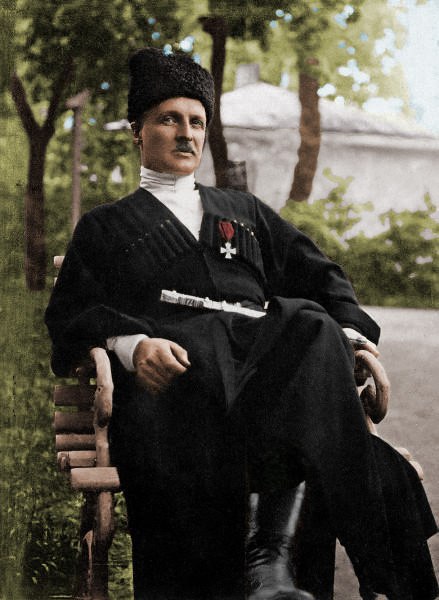
After the signing of the Brest-Litovsk peace treaty between the Ukrainian People’s Republic and the states of the Central Powers in February 1918, the advance of the allied troops made it possible to liberate most of Ukraine’s territory from Bolshevik forces. However, the very first contacts between German military and diplomats with representatives of the UNR (Ukrains’ka Narodna Respublika; Ukrainian People’s Republic) government revealed the inability of the Ukrainian authorities to fulfil their obligations regarding the supply of food and raw materials as stipulated by the treaty. In this situation, Berlin and Vienna reached the decision to replace the socialist Central Rada with a conservative Ukrainian government. On 29 April 1918, at the All-Ukrainian Congress of Grain Growers in Kyiv, General Pavlo Skoropadsky, a Russian aristocrat and descendant of an old Ukrainian Cossack-hetman lineage, was proclaimed Hetman of all Ukraine.
Thus began the history of the Ukrainian Hetmanate State, which has received several names in historiography: the Hetmanate of 1918, the Modern Hetmanate, and the Ukrainian State (in accordance with its official name). This was one of the most significant stages of the Ukrainian Revolution of 1917–1921, reflecting an attempt to build statehood on the foundation of conservative-liberal and monarchist ideologies. The new polity assumed the form of a hetmanate, characteristic of Ukrainian history and the political tradition of the seventeenth and eighteenth centuries. This state formation, however, acquired only certain external features of the old Hetmanate, while the main foundations of its internal policy were shaped according to the immediately accessible political and legal templates of the Russian imperial tradition.
This article examines the specific directions of the internal policy of Pavlo Skoropadsky’s Ukrainian State, in which tendencies toward the restoration of institutions from the Russian imperial legacy were manifested most clearly. Above all, this concerns the formation of the constitutional principles of the Hetman regime; the construction of the state-political model; the implementation of land reform; and the reorganization of local self-government.
Contemporaries of the revolutionary events who belonged to socialist and nationalist (independence-oriented) circles generally assessed Hetmanate Ukraine and Pavlo Skoropadsky himself with considerable scepticism. In their writings, leaders of Ukrainian socialist parties and prominent figures of the Central Rada characterized the Hetmanate regime as anti-Ukrainian, counterrevolutionary, and reactionary.[1]
In particular, former head of the General Secretariat of the Central Rada, Volodymyr Vynnychenko, called the “Hetmanate of 1918” a “national counterrevolution” in comparison with the UNR.[2] Another contemporary of those events, the future Prime Minister of the UNR, Isaak Mazepa, noted, “This was a decisive and ruthless restoration of the old pre-revolutionary order, in both the social and the national sense”.[3] Mazepa employed the notion “restoration” in regards to the internal policies of the Ukrainian State more frequently than others.[4] Yet another ideological opponent of the Hetmanate, member of the Central Rada Mykola Halahan, postulated, “What was restored was essentially the ‘old regime’, just named differently”.[5]
Soviet historiography interpreted the Hetmanate of 1918 as a “counterrevolutionary” formation, viewing it as “a bourgeois-landowner dictatorship embodied by a puppet government headed by the former tsarist general P. P. Skoropadsky”.[6] In Ukrainian émigré historiography, Hetmanate Ukraine and Pavlo Skoropadsky were assessed more pragmatically. Historians argued that he sought to restore stability by reintroducing the pre-revolutionary socio-economic order, as well as by emulating the system that had existed under the Tsarist regime.[7]
Contemporary Ukrainian scholars point to the anti-revolutionary orientation of the establishment of the Hetmanate of 1918. Some qualify it as a state coup, an attempt by conservative political forces to extinguish the flames of revolution,[8] while others argue that it was a counterrevolutionary coup that interrupted the revolution’s development along a democratic path and took on an anti-democratic character.[9] Notably, in recent scholarship the term “counterrevolutionary” is no longer used to characterize Hetmanate Ukraine.
Moreover, Pavlo Skoropadsky’s Hetmanate has gained broad recognition in historical literature as one of the stages of the Ukrainian Revolution of 1917–1921, with its own distinctive model of governance.[10] The Hetman’s state-building project can formally also be qualified as a revolution because it dismantled the previous socio-political system established by the socialist Central Rada. It is in this sense that Yurii Tereshchenko interprets the history of the Hetmanate of 1918 as a “conservative revolution”.[11]
It is worth clarifying the terminological apparatus of this study. Generally speaking, the lexicon of Hetmanate acts and governmental documents does not contain the notion of restoration. The terms most often used are “reconstruction”, “renewal”, and “revival”. Notions such as “Ukrainian State”, “Hetmanate of 1918”, and “Hetmanate of Pavlo Skoropadsky” are employed as fully synonymous. Nevertheless, the latter two are more frequently used, since the official name of the Hetmanate – “Ukrainian State” – coincides with the broader concept of “Ukrainian state”, which also includes the UNR and the ZUNR (Zakhidnoukrains’ka Narodna Respublika; West Ukrainian People’s Republic). The events under study took place within 1918, therefore only day and month are indicated.
The notion of “restoration” (from the Latin restauratio – renewal, reconstruction) has several meanings. The first and most common pertains to the fields of art, architecture, and construction. In the realm of political relations, restoration is regarded as the re-establishment of order and relations overthrown during periods of great socio-political upheaval.[12] Many political and socio-economic processes in world history can be qualified as “restorations”. Some examples include the Medici Restoration in Italy, the Bourbon Restoration in France, the Stuart Restoration in England, and the Meiji Restoration in Japan.
By restorationist tendencies within the internal policy of the Hetmanate in 1918, we refer to the phenomena and processes of that time connected with the partial revival of political, social, and legal attributes of the pre-revolutionary order. We do not assess them as negative. On the contrary, we regard them as the objective product that was determined by the nature of the Hetman’s rule, the character of planned conservative reforms, and the influence of the German-Austrian allies.
The Hetmanate emerged as an alternative to the UNR, interrupting the national-democratic stage of the Ukrainian Revolution of 1917–1921.[13] The question of the nature of the new authority arose immediately after General Pavlo Skoropadsky was proclaimed Hetman. The Bolshevik leadership, forced by the conditions of the separate peace treaty with the states of the Central Powers to conclude an armistice with the UNR, closely monitored developments in Ukraine.
Having examined the content of the Hetman’s first public acts and the composition of his government, Bolshevik leader Vladimir Lenin assessed the political situation in Ukraine as a “restoration of bourgeois-landlord monarchism in Ukraine with the support of the Cadet-Octobrist elements of the All-Russian bourgeoisie and with the help of German troops”.[14] He emphasized the restoration of private property rights, which returned industrial and agrarian bourgeois elites to power, and the predominance of Russian Cadets in the Hetman government. Equally evident to him was the role of the German military command in carrying out the state coup.
Russian liberal periodicals also responded to the change of power in Ukraine in April 1918. In the newspaper Nash vek(formerly Rech’) it was noted that the Ukrainian Hetman was a figure acceptable from the standpoint of Great Russian interests. Another newspaper, Den’, considered the Tsarist aristocrat Pavlo Skoropadsky more of a Russian than a Ukrainian candidate.[15]The German official press generally evaluated the Hetman positively, attempting to convince the public of the German command’s non-involvement in the coup. At the same time, the German Social Democratic newspaper Vorwärts published an essay about the change of power in Ukraine under the headline ‘Counterrevolution’. According to that paper, the elements who came to power with German help would, with raised banner, pass over to Russia’s side when a new bourgeois government came to govern in Moscow.[16] Another influential paper, the Frankfurter Zeitung, wrote that Ukrainian socialists had remained outside the government, while people not entirely free of Russophile and Tsarist sympathies had joined the Hetman.[17]
The Ukrainian socialist parties, excluded from power and having failed to secure positions within the system of state authority from either the German command or Skoropadsky, moved into opposition to the Hetman regime. On 21 May, they issued a memorandum containing stinging assessments of the government’s first steps. The memorandum stressed,
The new Council of Ministers included Russian Cadets, Octobrists, and, in general, representatives of those non-Ukrainian groups that had always been hostile to the Ukrainian movement and Ukrainian statehood and fought against them with all their strength in the name of a “united, indivisible Russia”.[18]
The government was also reproached for banning zemstvo (workers’, and peasants’ congresses), while assemblies of representatives of capital, trade, and large agrarian property were held with the participation of ministers. The document further emphasized the “replacement of the Ukrainian element in all ministries with a non-Ukrainian one, chiefly Great Russian”, the “domination of the Russian language in the courts”, and the “restoration of censitary dumas and zemstvos”.[19]
At the same time, the leadership of the All-Ukrainian Zemstvo Union, headed by Symon Petliura, the former General Secretary of Military Affairs in 1917, stated in a declaration sent to the ambassadors of Germany and Austria-Hungary that,
[The new government] with its policy of ruthless reaction and restoration of the old order, has provoked new waves of anarchy, uprisings, armed rebellion, and spontaneous agrarian terror, has drawn upon itself complete mistrust and bitter hostility from broad circles of the population, and has shaken the very foundations of Ukrainian statehood.[20]
The Hetmanate of 1918 emerged as an alternative to the authority of the Central Rada and the dominance of socialist parties. It rested upon conservative-liberal foundations and the support of the German Empire. The restoration of private property rights, the strengthening of Russian political influence, and the orientation toward imperial legacies provoked resistance among opposition political circles and the wider population. The Hetmanate of 1918 was perceived not only by Ukrainian opposition forces but also by ideological opponents in Germany and in the former Russian Empire as an attempt to restore the pre-revolutionary order.
MAJOR TENDENCIES OF THE HETMANATE’S RESTORATION
The two fundamental documents of the new head of state – the Manifesto to the Entire Ukrainian People and the Laws concerning the Provisional State System of Ukraine – were dated 29 April 1918, the day the coup d’état took place and the Central Rada lost its power.[21]
According to the text of the Manifesto, Pavlo Skoropadsky proclaimed himself Hetman of all Ukraine, explaining that he was compelled to take such a step by the threat of a new catastrophe for Ukraine and by the categorical demands of the working masses to “immediately establish such a State Authority that would be capable of ensuring peace, law, and the possibility of creative labour for the population”.[22] The main purpose of the Manifesto was to inform the Ukrainian people about the reasons for the change of political system and to declare the programmatic principles of the new government.
The Laws concerning the Provisional State System of Ukraine consisted of seven acts: ‘On Hetman Authority’, ‘On Faith’, ‘On the Rights and Duties of Ukrainian Cossacks and Citizens’, ‘On Laws’, ‘On the Council of Ministers and on the Ministers’, ‘On the Financial Council’, and ‘On the General Court’. The preamble emphasized that these laws would remain in force only until the election of the Sejm and the beginning of its work.[23] Throughout the existence of the Ukrainian State, this set of laws de facto functioned as its constitution. Taken as a whole, these legal acts were intended to ensure the maximum concentration of power in the hands of a single person – the Hetman.
The preparation of the first state acts of the 1918 Hetmanate is associated with the jurist Aleksandr Paltov – a native of St. Petersburg and a graduate of the Faculty of Law at the local university. During the First World War, he served as legal adviser to the Directorate of the Halychyna-Bukovyna Railway. In the spring of 1918, he joined Pavlo Skoropadsky’s oriented political organization, the Ukrainian National Hromada.
In his memoirs, Skoropadsky recalled the important role played by Paltov in drafting the Hetman’s address to the Ukrainian people. On 25 April after noting down the general’s ideas, Paltov prepared an almost complete draft of the Charter in just an hour and a half. Skoropadsky was struck by Paltov’s “clarity of mind and speed of work in such a complex matter”.[24]
Some scholars argue that it was in fact Paltov who authored the Laws concerning the Provisional State System of Ukraine,since he held pronounced monarchist convictions and, throughout the existence of the Ukrainian State in 1918, never abandoned hope of transforming it into one or another form of monarchy.[25] Only a committed monarchist and an expert in Russian imperial law could prepare the draft of the Laws concerning the Provisional State System of Ukraine so swiftly. Immediately after the Laws was published, contemporaries admitted that they were modelled on the text of the Code of Laws of the Russian Empire in its 1906 edition. The Kyivan jurist Aleksei Goldenveyzer recalled:
When they began to read aloud, article by article, this hastily baked constitution, it struck me as suspiciously familiar. I took from the shelf Volume 1, Part 1 of the Code of Laws and began comparing what I heard with the Fundamental Laws from 1906. It turned out that, with exception of a few digressions, the Hetman’s constitution reproduced these Fundamental Laws.[26]
In his article ‘The Central Powers and Ukraine’, the famous German scholar Professor Otto Hötzsch also noted that the Hetman’s proposed Constitution was derived from the Fundamental Law of the Russian Empire of 1906.[27]
The Fundamental State Laws of the Russian Empire constituted the code of laws outlining the general state system of the Russian Empire. Under the guidance of Russian (statemen and) jurist Mikhail Speranskii, they were codified and went into effect in 1833. In April 1906, in light of the revolutionary crisis of 1905, the Fundamental Laws were amended in connection with the establishment of the State Duma and the reorganization of the State Council. The amended laws now consisted of two sections, 17 chapters, and 223 articles.[28]
A comparison of the articles in the Code of Laws of the Russian Empire and the Laws concerning the Provisional State System of Ukraine shows that out of 24 articles in the first chapter of the Code, only eight were incorporated into the legislation of the Hetmanate Ukraine. The technique used in drafting these articles was quite superficial: the phrase “His Imperial Majesty” or “Emperor of All Russia” was replaced with “Hetman”, and the text was translated into Ukrainian language. It is evident that the phrase “Russian State”, present in the original text, was used as a model for the official name of the Hetmanate of 1918 – the “Ukrainian State”.
The first law declared the Hetman’s exclusive authority over the entire Ukrainian State. He appointed the head of government, confirmed and dismissed its members, and retained the right to appoint and dismiss other government officials. The Hetman exercised general leadership over foreign policy, served as the Supreme Commander of the Armed Forces, had the power to grant amnesty, and so on. All orders and decrees of the Hetman were to be countersigned by the head of government or the relevant minister.
Nearly all of the articles of the Hetmanate’s Laws concerning the Provisional State System of Ukraine were “written” in such a manner. Unsurprisingly, the provisions of the relevant Russian law concerning the State Council and the State Duma as institutions meant to restrain the emperor’s power were omitted. In the political system of the Hetmanate, representative bodies were absent altogether, and the functions of representation were concentrated in the hands of the head of state. At the same time, within the socio-political situation of 1918, the Hetman’s political and military dependence on the German military command and diplomacy significantly curtailed his actual authority.
The Council of Ministers, functioning as the highest legislative and executive body, was supported by the State Chancellery, headed by the State Secretary. The Ukrainian State Chancellery was established on the model of the State Chancellery of the Russian Empire, largely replicating its structure. The State Chancellery served as the supreme executive institution in the sphere of public administration. Its responsibilities, among other tasks, included drafting legislation, maintaining registries of state authorities and civil service appointments, and compiling formal personnel records.[29]
It’s worth mentioning that Pavlo Skoropadsky’s first choice for the post of State Secretary – Mykhailo Hizhytskyi, a member of the Ukrainian National Hromada – was unsuccessful. By contrast, his successors, a lawyer Ihor Kistiakovskyi and Serhiy Zavadskyi, Deputy Ober-Prosecutor of the Russian Senate, distinguished themselves not only as talented jurists but also as effective administrators.
Among the urgent measures to establish a centralized vertical of power, a special role was assigned to local administrative bodies. By decree of the Hetman, the positions of gubernia commissioners of the Central Rada and their assistants were abolished, and the office of gubernia starostas was introduced. By order of the Minister of Internal Affairs from 14 May all county commissioners were dismissed, being replaced by county starostas.[30] The Ministry of Internal Affairs of the Ukrainian State rejected the project of the administrative-territorial reform planned by the Central Rada, which had envisioned dividing Ukraine into lands, and retained the old structure: gubernia–county–volost.
The following individuals were appointed as gubernia starostas:
Volhynia: Dmytro Andro, landowner;
Katerynoslav: Ivan Chernikov, general and landowner;
Kyiv: Ivan Chartoryzhskyi, former tsarist governor;
Poltava: Serhiy Ivanenko, zemstvo activist and landowner;
Podillia: Serhiy Kysilyov, landowner;
Kharkiv: Petro Zaleskyi, general and landowner;
Kherson: Semen Pyshchevych, landowner;
Chernihiv: Mykola Savytskyi, zemstvo movement activist and landowner.
To enforce “peace and order” locally, they were granted powers exceeding those of the former Tsarist governors: conducting searches, making arrests, and carrying out deportations of up to two years, including beyond the borders of Ukraine.
The Deputy State Secretary of the Ukrainian State, Mykola Mohylianskyi, recalled the difficulties of assembling the local administrative apparatus, when “with fatal inevitability we had to return to power and recruit for the new administration those with experience from the old regime, who were, moreover, deeply angered by all preceding actions”.[31] Consequently, the actual transfer of power in the provinces to the landowners was one of the Hetman’s fundamental mistakes. On the one hand, it was thanks to their support that he became head of state and should have continued to seek their backing. On the other, these very landowners, through their “reparative” campaigns and punitive expeditions against the peasantry, provoked a powerful insurgent movement and further intensified the widespread discontent with the domestic policies of the Hetman’s government.
In governing the largest cities, the Hetman’s government effectively reverted to a pre-revolutionary model. In particular, by the Law of 1 August 1918, the Kyiv City Governorate was established under the authority of a Chief Otaman, modelling the former Russian gradonachalstvo (city governorate).[32] The law referred explicitly to the relevant articles of the General Provincial Statute(Code of Laws, vol. 2, ed. 1892).
Following Kyiv, administrative units of otamanstvo were also created in Odesa and Mykolaiv. The heads of these administrations were General Oleksandr Khanukov in Kyiv, General Edward de Bondy in Mykolaiv, and General Volodymyr Mustafin in Odesa. As Russian political activist Venedikt Myakotin recalled,
In Odesa, V. Mustafin attempted to reinstate the practices of the pre-revolutionary era. This city governor succeeded in closing the Odesa City Duma, elected in 1917, and transferring the city’s administration back to the pre-revolutionary governing body.[33]
Thus, the Hetman’s government deliberately employed the administrative, legal, and managerial experience of the imperial period to improve the functioning of state institutions. However, this policy encountered misunderstanding and resistance not only from political opponents and the opposition, but also from the majority of the peasantry and urban population.
The aforementioned Manifesto by Pavlo Skoropadsky from 29 April 1918, which many scholars consider his inaugural decree, provides an exceptionally important and now canonical statement:
The right to private property, as the foundation of culture and civilization, is hereby fully restored, and all decrees of the former Ukrainian government, as well as those of the Russian Provisional Government, are repealed and nullified. Full freedom to draw up contracts for the purchase and sale of land is reinstated.[34]
This provision is key to understanding the ideology behind Pavlo Skoropadsky’s conservative-liberal reforms. It is most clearly reflected in the implementation of land reform, whose idea was entirely progressive: to provide land to smallholding peasants, thus creating a stable socio-political base for the state authority.
The reform was designed to progress through three stages. The first was the return of land seized by peasants to its former owners. The second was the redemption of that land from those owners through a special state bank. The third, through the bank’s mediation, was the sale of plots to smallholding peasants. However, the reform never advanced beyond the first stage, i.e., the restoration of landlords’ estates.[35]
By adopting the Law on Land Liquidation Commissions on 6 July, the Council of Ministers created a legal foundation for the landowners’ unrestricted “reparative” campaigns against the peasantry. A six-month period was established for satisfying the claims of landowners, and, crucially, approximate calculations of their losses were permitted. The government also restored the legal force of the Regulation on Land Management of 1912 from the Russian Empire.[36]
In the summer, this “restorative” practice by the landowners became widespread and provoked a counter-reaction from the peasantry, which escalated into large-scale armed insurgent resistance, directed not only against the landowners but also against the state authority embodied by the Hetman. In August, the head of the Ministry of Internal Affairs, Ihor Kistiakovskyi, was compelled to send a circular to the gubernia starostas aimed at restraining landowners’ arbitrariness. The document emphasizes, “In many areas, privately funded punitive detachments are still operating, committing acts of violence. I deem it necessary to halt such activities by these punitive detachments, for they needlessly provoke the population”.[37]
It was only in September that a Land Bank was finally established; however, it practically never engaged in land transactions. At the time, Dmytro Dontsov, director of the Ukrainian Telegraph Agency, noted in his diary,
We receive nothing from the land banks. No one is selling or buying anything. And when sales do occur, it is large landowners selling to other large landowners. The form of sale is a mortgage.[38]
Under revolutionary conditions, the principle of the inviolability of private property rights (while being reasonable from a theoretical standpoint) resulted in nothing more than a restoration of large landownership. This principle failed to bring about the parcelling of agricultural estates and their sale to smallholding peasants.
The achievements of the Ministry of Land Policies, led by Vasilii Kolokoltsov and Volodymyr Leontovych, laid the foundation for the legislative framework necessary for carrying out liberal land reform. This gave Pavlo Skoropadsky grounds to later claim, “Never before has the agrarian question been so close to a reasonable resolution as it was in November 1918 in Ukraine”.[39]
However, Hetman’s assessment of the situation was too optimistic. In reality, by November, both old and new obstacles remained on the path to implementing the reform. The legally defined term for settling land and property disputes between peasants and landowners was nearing its expiration at the end of the year, after which land sales to peasants were expected to begin.
At that time, Pavlo Skoropadsky was unable to overcome resistance on the agrarian question from such powerful corporate landowning organizations as the Union of Landowners and PROTOFIS.[40] The defeat of the Central Powers in the First World War had become inevitable. Landowners were anticipating the arrival of Entente troops and their Russian allies, hoping they would bury the very idea of Hetman Skoropadsky’s reform. Moreover, the Ukrainian peasantry, spoiled by the lure of free “socialization” of land, was unwilling to pay for it. The almost apocryphal nature of the Hetman’s regime carried the threat of a sudden change in power and, consequently, the possible expropriation of lands purchased.
Commenting on the meagre results of the land reform, the director of the Land Bank, Roman Budberg, wrote in his memoirs:
During the existence of the State Land Bank, about 40,000 tithes of land were purchased, but only two estates had their deeds notarized: one in the Kyiv Governorate and one in the Kharkiv Governorate. All other agreements could not be finalized as senior notaries, estate owners, and even the Bank’s branches themselves had become inaccessible.[41]
The unfinished land reform resulted in a restoration of large landownerships and widespread discontent among the peasantry. The peasantry, in turn, formed the backbone of the Directory’s insurgent army, therefore sealing the fate of the Hetmanate Ukraine. It is no coincidence that in one passage of his memoirs Skoropadsky expressed himself quite emotionally, referring to “that cursed land question”.[42]
Another sphere where the processes of reverting to imperial practices manifested most fully was the judicial branch. It underwent substantial changes compared to the times of the UNR, evolving toward the restoration of the Russian imperial judicial system. The laws on the provisional state system of Ukraine envisioned the creation of the General Court as “the highest guardian and protector of the law, and the Supreme Court of Ukraine in judicial and administrative matters”.
The General Court was the highest judicial institution of the Hetmanate of the seventeenth and eighteenth centuries, as well as of the UNR. However, in early July 1918 the government adopted a law establishing, after the model of the Ruling Senate of the Russian Empire, the highest judicial authority of the state – the State Senate of the Ukrainian State.[43] Its activities were regulated by acts of the Russian Empire: the Establishment of the Ruling Senate of Russia, the Establishment of Judicial Institutions, and the Statutes of Criminal and Civil Procedures. The State Senate comprised three general courts: civil, criminal, and administrative.[44]
Hetman Skoropadsky appointed Mykola Vasylenko, Minister of Education and Vice-Premier, as the President of the Senate. As in Tsarist Russia, so too in the Ukrainian State, senators could be appointed from among statesmen who lacked formal legal education or professional experience. Skoropadsky, in particular, appointed the following figures to the General Assembly of the State Senate: Prime Minister Fedir Lyzohub, former Kyiv Mayor Ippolit Dyakov, Ukrainian public activist Petro Stebnytskyi, and others.
The orientation toward the judicial system of the Tsarist era was also evident in the abolition of the Central Rada’s law on appellate courts and the reinstatement, as before, of three Judicial Chambers in Kyiv, Kharkiv, and Odesa. To ensure their functioning, the Russian law of 3 July 1914, was reinstated.[45]
Lacking the ability to quickly draft its own criminal procedure legislation, the state authorities were forced to widely use the Code of Punishments of Criminal and Correctional Law of 1885, with its amendments from 1912. In the realm of combating speculation, the Ministry of Finance was granted the authority to interpret relevant articles and issue instructions. As a rule, in this manner the former Russian legislation was adapted to Ukrainian realities. The aforementioned Code effectively extended to all types of offenses.
The shortage of local legal professionals forced the government to keep office personnel from former Russian judicial institutions who had been deployed to Ukraine during the war. This circumstance created further obstacles to introducing the Ukrainian language in courts. These were necessary but temporary measures, prompted by the shortage of professional jurists and the underdevelopment of Ukraine’s own legislative base. Their overly broad implementation was also exacerbated by the conditions of foreign occupation and the jurisdiction exercised by German and Austrian military field courts over Ukrainian people.
Among the law enforcement bodies, the State Guard – a network of armed units combining the functions of the pre-revolutionary police and gendarmerie – became one of the most influential. Already in May, the government passed a resolution that annulled the decisions of the Provisional Government and the Ukrainian Central Rada regarding the creation of militia formations. Municipal and district militia forces were reorganized into the State Guard, subordinated to the Ministry of Internal Affairs. Work on drafting the statute of this institution continued for some time, drawing from the legislation of the Russian state, particularly the Code of Criminal Procedure.[46]
The personnel of the State Guard units consisted of former policemen, gendarmes, city constables, wardens, officers, and non-commissioned officers. Upon returning to service, they brought with them the experience of the imperial security apparatus and reinstated the operation of the old network of informants. Prosecutorial oversight of the activities of State Guard officers remained largely formal.
Local self-governing bodies had undergone substantial changes during the revolution. The zemstvo assemblies and local city councils, elected under the Provisional Government’s legislation, had become highly politicized; their composition included numerous representatives of left-wing parties, members lacking professional expertise, even those with no real ties to local communities. Both Prime Minister Fedir Lyzohub, one of the most prominent zemstvo leaders of the Russian Empire, and Hetman Pavlo Skoropadsky perceived this state of self-governing bodies as a threat to the implementation of planned reforms. It is evident that another contributing factor was the leadership of the All-Ukrainian Zemstvo Union, which at the time was headed by the aforementioned Symon Petliura.
From the very outset, zemstvo bodies were subjected to pressure from the local administration. The dissolution of zemstvoassemblies and boards was widely practised. Frequently, in their place, the operation of old property-qualifying (tsenzovyi) institutions was reinstated. The persecution of local self-government reached such proportions that it compelled Prime Minister and Minister of Internal Affairs, Fedir Lyzohub, to urgently dispatch circulars to the gubernia starostas, prohibiting the dissolution of zemstvo and municipal councils while permitting the suspension of their activities only in cases of overt revolutionary agitation against the existing order.[47]
In May, a commission was established to draft a new law on zemstvo elections, headed by Prince Aleksandr Golitsyn – a Russian landowner, chairman of PROTOFIS, and former member of the Russian State Duma. The commission submitted a bill copied directly from an imperial text, based on the curial system. Most Kadet ministers recognized that it “deepened the divide between individual classes” and was undemocratic, yet they deemed it “politically expedient” to limit access to zemstvo elections for “elements dangerous from a political standpoint”.[48]
On this matter, the Kadet ministers significantly deviated from the party’s programmatic provisions, which had stipulated that elections to zemstvo and municipal assemblies were to be “based on universal, equal, direct, and secret vote, without distinction of sex, religion, or nationality”.[49] The government also approved new electoral legislation, which annulled the Provisional Government’s law of 21 May 1917, on zemstvo elections, introducing instead substantial curial restrictions based on the following:
property requirements: only individuals owning property subject to zemstvo taxation were allowed to participate in the vote for zemstvodeputies (zemskiye glasnyie);
residence requirements: at least one year;
age requirements: 25 years old;
gender restrictions: only female property owners;
socio-professional restrictions: military personnel, students, monks, and other categories were not allowed to participate.[50]
A similar law on elections to municipal dumas, drafted by Ippolit Dyakov’s commission, was also adopted. After these laws were ratified by the Hetman in September 1918, the activities of local self-government bodies were entirely suspended until the new elections scheduled for November–December of that same year. The fall of the Hetman regime prevented these elections from taking place.
The analysis of internal policy of the Ukrainian State allows us to conclude that it was marked by restorationist tendencies. The provisional and extraordinary nature of the Hetmanate served as a certain imperative for the state leadership to draw upon elements of the Russian imperial legal tradition, which was familiar and accessible to the local ruling elite.
The constitution, state institutions, and judicial bodies were formed and functioned based on the imperial Russian legislation, only slightly adapted to Ukrainian realities. The shortage of national personnel and specialists was offset by the extensive involvement of Russian lawyers in the judiciary and prosecution services, which undermined the foundations of the 1918 Hetmanate not only as a legal state but also as a national one.
In the sphere of economic policy, the restoration of the primacy of private property rights and intentions to implement a liberal agrarian reform led to the return of land to landlords, inspiring a social backlash against the peasantry. The participation of law enforcement agencies and occupation forces on the side of landowners in this process turned the largest social class – smallholding and landless peasants – against the Hetman’s rule.
The government’s declared goals of restoring order, peace, and social partnership among all classes effectively resulted in the restriction of democratic freedoms, the abolition of local self-government institutions, and the strengthening of the state’s repressive functions. This led to an acute social conflict between two elements of the political system – local self-government and the executive branch – which culminated in the practical elimination of democratic organs of local governance and the directive reinstatement of pre-revolutionary zemstvo boards and city dumas.
The restorationist tendencies dominated the domestic policy of the Ukrainian Hetmanate of 1918. At the same time, another process was taking place – a project of national and cultural development initiated by the Central Rada. Ukrainian gymnasiums were opened, Ukrainian textbooks were published in large print runs, and courses in Ukrainian Studies for teachers were organized. Two Ukrainian universities were established, as well as departments of Ukrainian Studies in higher educational institutions, the Academy of Sciences, a number of cultural institutions, and a National Archive.
This ideological and political duality of the Hetmanate’s domestic policy reflected the ambivalent Russian-Ukrainian loyalties of the head of state and the ruling elite. It is precisely these features that led contemporary researchers to interpret the Hetmanate of 1918 as being “neither Ukrainian nor Russian statehood”, or as a “Little Russian project”.[51]
The defeat of the Central Powers – the Hetmanate’s allies – in the First World War confronted Pavlo Skoropadsky with the urgent challenge of preserving Ukrainian statehood. He was compelled to make a dramatic shift in political course, effectively renouncing state independence in pursuit of the favour of the victorious Entente powers. In this respect, the Hetman’s Federative Charter of 14 November 1918, was a product of a critical convergence of adverse circumstances. To a great extent, it was enabled by Herman’s double identity, in which Ukrainian and Russian mentality coexisted. In the geopolitical context of the time, the latter prevailed and even imbued the Hetman with confidence that “Greater Russia would be restored on federative principles, with all nationalities entering into a great state as equals among equals…”.[52] It was only in emigration, under the influence of Viacheslav Lypynskyi, the founder of Ukrainian conservatism, and other leaders of the Hetmanate movement, that Skoropadsky abandoned his visions of a Greater Russia. Yet he turned instead to another equally illusory project – a Ukrainian hereditary labour monarchy.
CONCLUSION
The key contradiction in the history of Hetmanate Ukraine in 1918 lay in the attempt to reconcile modernization and national objectives with a reliance on imperial legal and political traditions. One of the fundamental aspects of this restoration course was the formation of the constitutional foundations of the Hetman regime. In essence, the Laws Concerning the Provisional State System of Ukraine largely reproduced the Fundamental Laws of the Russian Empire from 1906, merely substituting the terminology. This ensured the concentration of power in the hands of the Hetman and his government, creating a strong vertical of authority, but overall stripping the political system of democratic substance. Such an approach, on the one hand, allowed decisions to be made swiftly in a context of war and foreign presence or atypical occupation; on the other hand, it laid the groundwork for mistrust from the peasantry and resistance from democratic and socialist factions.
Restorationist elements in domestic policy were also evident in the system of local governance. The introduction of the institution of gubernia and county starostas, whose powers exceeded those of pre-revolutionary governors, demonstrated a course toward centralization of authority and strengthening of administrative control. The transfer of real power in the localities into the hands of landlords and former officials of the imperial administration provoked particular resentment among the peasantry, since landlords were seen as the embodiment of the old social oppression. As a result, instead of bringing social stability, this policy contributed to the spread of the insurgent movement.
The most painful sphere for the Hetman regime was agrarian policy. The proclaimed idea of a liberal land reform, which envisioned the purchase of land by a state bank and its transfer to smallholding peasants, in practice devolved into a restoration of landlord ownership. The return of estates seized during the revolutionary period to their former owners triggered bitter conflicts. Peasants, who had already experienced “socialization” of land, had no wish to once again become dependent on their landlords. Punitive actions by the Hetman’s guard, coupled with the intervention of German and Austrian troops, only exacerbated tensions.
The judicial system of the Ukrainian State was likewise built on Russian imperial models. The creation of a State Senate modelled after the Senate of the Russian Empire, the reinstatement of old procedural norms, and the involvement of former Russian jurists – all this made the judiciary branch far removed from national and democratic aspirations. The shortage of national personnel and the practical impossibility of introducing the Ukrainian language in courts further eroded public trust. Thus, in the field of justice, restorationist tendencies became especially pronounced as they almost entirely reproduced imperial practices.
In the sphere of local self-government, the Hetman’s authority openly curtailed democratic freedoms. The dissolution of zemstvo assemblies and municipal dumas, the return to the property-qualifying principles of elections, the introduction of age and social restrictions – all these measures confirmed the intention to eliminate “dangerous” political elements from influencing those in power. Rather than stabilizing the situation, such policies further alienated Ukrainian political forces from the Hetman’s government and fuelled opposition sentiment. At the same time, we should emphasize that the restorative policy was not the sole defining feature of the Hetmanate of 1918. In parallel, the trajectory initiated by the Ukrainian Central Rada toward the national and cultural development was also pursued.
The contradictory character of the Hetmanate of 1918 can also be explained by the personality of Pavlo Skoropadsky. His dual identity of a Ukrainian Hetman and a Russian general was reflected in all his policies. On the one hand, he sought to stabilize the situation, build an effective state, and implement cultural and educational initiatives. On the other, he leaned toward imperial traditions, relying on Russian Kadets and landlords, which ran counter to the national revolutionary expectations of the time. This ambivalence, compounded by dependence on German and Austro-Hungarian allies, rendered the regime ideologically vulnerable and politically unstable.
In conclusion, it can be argued that the Hetmanate of 1918 was an attempt to reconcile diverse political traditions and respond to the challenges of its time. Its restorationist tendencies, such as the use of imperial legislation, the reinstatement of landlord estates, and the dismantling of democratic institutions, proved dominant, ultimately shaping the social conflict that became one of the key reasons for the regime’s downfall. Thus, the domestic policy of the Ukrainian State was both a lesson and an experiment. While its restorationist features led to the fall of Hetman authority, its national and cultural achievements demonstrated that efforts to lay the foundations of a modern Ukrainian statehood were possible even in the most difficult conditions of war and revolution.
BIBLIOGRAPHY
Chrystjuk, Pavlo, Zamitky i materijaly do istoriji Ukrajinsʹkoji revoljuciji 1917–1920 rr., 4 vols (Videnʹ: Ukrajinsʹkyj Sociolʹogyčnyj Іnstytut, 1921), III
Čykalenko, Jevhen, Ščodennyk, 2 vols (Kyjiv: Tempora, 2004), II
Doncov, Dmytro, Rik 1918, Kyjiv (Kyjiv: Tempora, 2002)
Golʹdenvejzer, Aleksei, ‘Iz kievskich vospominanij’, in Revoljucija na Ukraine po memuaram belych, ed. by Sergej Alekseev (Moskva–Leningrad: Gosizdat, 1930)
Gorʹkij, Maksim and Isaak Minc, eds, Krach germanskoj okkupacii na Ukraine (po dokumentam okkupantov) (Moskva: Gosizdat., 1936)
Haj-Nyžnyk, Pavlo, ‘Oleksandr Paltov – zastupnyk ministra zakordonnych sprav Ukrajinsʹkoji Deržavy (1918 r.)’, Ukrajina dyplomatyčna, 12 (2011), 869–81
Halahan, Mykola, Z mojich spomyniv, 1880–1920 rr. (Kyjiv: Tempora, 2005)
Hrycak, Jaroslav, Narys istoriji Ukrajiny: formuvannja modernoji ukrajinsʹkoji naciji XIX–XX stolittja (Kyjiv: Heneza, 1996)
Hunčak, Taras, Ukrajina: perša polovyna XX st. Narysy polityčnoji istoriji (Kyjiv: Lybidʹ, 1993)
Ivantsova, Olga, ed., Getman P.P. Skoropadskij. Ukraina na perelome. 1918 god (Moskva: ROSSPÈN, 2014)
Korolov, Gennadij, ‘Ukrainskaja revoljucija 1917–1921 gg.: mify sovremennikov, obrazy i predstavlenija istoriografii’, Ab Imperio, 4 (2011), 357–75
Korolʹov, Hennadij, ‘Reheneracija ideji federalizmu v Ukrajinsʹkij hetʹmansʹkij deržavi 1918 r.: heopolityčni ta nacionalʹno-identyfikacijni čynnyky’, Problemy vyvčennja istoriji Ukrajinsʹkoji revoljuciji 1917–1921 rokiv, 8 (2012), 212–25
Levenecʹ, Jurij, ed., Polityčna encyklopedija (Kyjiv: Parlamentsʹke vydavnyctvo, 2011)
Lytvyn, Volodymyr, Ukrajina: dobavijn i revoljucij (1914–1920) (Kyjiv: Alʹternatyvy, 2003)
Mazepa, Isaak, Ukrajina v ohni i buri revoljuciji (1917–1921) (Kyjiv: Tempora, 2003)
Mjakotin, Venediktm ‘Iz nedalekogo prošlogo’, in Revoljucija na Ukraine po memuaram belych, ed. by Sergej Alekseev (Moskva–Leningrad: Gosizdat, 1930), 222–38
Mogiljanskij, Nikolaj, ‘Tragedija Ukrajny’, in Revoljucija na Ukraine po memuaram belych, ed. by Sergej Alekseev (Moskva–Leningrad: Gosizdat, 1930), pp. 115–35
‘Programma konstitucionno-demokratičeskoj partii. [1905 g.]’, in Sbornik programm političeskich partij v Rossii, ed. by Vasilij Vodovozov (Sankt-Peterburg, 1905–1906), I (1905), pp. 34–49
Pyrih, Ruslan, and Roman Tymčenko, Zemelʹna reforma hetʹmana Pavla Skoropadsʹkoho: istoryčni narysy, dokumenty j materialy (Kyjiv: Іnstytuti storiji Ukrajiny NANU, 2025)
Pyrih, Ruslan, ed., Ukrajinsʹka Deržava (kvitenʹ – hrudenʹ 1918 roku). Dokumenty i materialy, 2 vols (Kyjiv: Tempora, 2015)
Pyrih, Ruslan, Hetʹmanat Pavla Skoropadsʹkoho: miž Nimeččynoju i Rosijeju (Kyjiv: Іnstytut istoriji Ukrajiny NANU, 2008)
Pyrih, Ruslan, Ukrajinsʹka hetʹmansʹka deržava 1918 roku: Іstoryčni narysy (Kyjiv: Іnstytut istoriji Ukrajiny NANU, 2011)
Pyrih, Ruslan, Vidnosyny Ukrajiny i Centralʹnych deržav: netypova okupacija 1918 roku (Kyjiv: Іnstytutistoriji Ukrajiny NANU, 2018)
Skoropadsʹkyj, Pavlo, Spohady. Kinecʹ 1917 – hrudenʹ 1918 (Kyjiv–Filadelʹfija, 1995)
Smolij, Valerij, ed., Іstorija Ukrajiny: nove bačennja, 2 vols (Kyjiv: Vyd-vo «Ukrajina», 1996)
Smolij, Valerij, Narysy istoriji Ukrajinsʹkoji revoljuciji 1917–1921 rokiv, 2 vols (Kyjiv: Naukova dumka, 2011), I
Soldatenko, Valerij, Ukrajina v revoljucijnu dobu. Іstoryčni ese-chroniky, 4 vols (Kyjiv: Svitohljad, 2009), II
‘Svod osnovnych gosudarstvennych zakonov (1906g.)’, Biblioteka Gumer – istorija, [n.d.] <http://www.gumer.info/Bibliotek_Buks/History/Article/svod_zak.php> [accessed 20 April 2025]
Subtelʹnyj, Orest, Ukrajina. Іstorija (Kyjiv: Lybidʹ, 1993)
Tereščenko, Jurij, ‘Hetʹmanat Pavla Skoropadsʹkoho jak projav konservatyvnoji revoljuciji’, Ukrajinsʹkyj istoryčnyj žurnal, 3 (2008), 19–37
V.І. Lenin pro Ukrajinu, 2 vols (Kyjiv: Politvydav, 1969), I
Velykyj Žovtenʹ i hromadjansʹka vijna na Ukrajini. Encyklopedyčnyj dovidnyk (Kyjiv: Hol. red. URE, 1987)
Verstjuk, Vladyslav, Viktor Horobecʹ, and Oleksij Toločko, Ukrajina i Rosija v istoryčnij retrospektyvi: Narysy, 3 vols (Kyjiv: Naukova dumka, 2004), I
Vynnyčenko, Volodymyr, Vidrodžennja naciji, 3 vols (Kyjiv-Videnʹ: Vydavnyctvo “Dzvin”, 1920), III
Žukovsʹkyj, Arkadij and Orest Subtelʹnyj, Narys istoriji Ukrajiny (Lʹviv. Vyd-vo NTŠ, 1991)
PRESS
Deržavnyj vistnyk, 1918
Frankfurter Zeitung, 1918
Neue Freie Presse, 1918
Nova Rada, 1918
Vorwarts, 1918
[1] For more details, see: Gennadij Korolov, ‘Ukrainskaja revoljucija 1917–1921 gg.: mify sovremennikov, obrazy i predstavlenija istoriografii’, Ab Imperio, 4 (2011), 357–75.
[2] Volodymyr Vynnyčenko, Vidrodžennja naciji, 3 vols (Kyjiv-Videnʹ: Vydavnyctvo “Dzvin”, 1920), III, p. 61.
[3] Isaak Mazepa, Ukrajina v ohni i buri revoljuciji (1917–1921) (Kyjiv: Tempora, 2003), p. 63.
[4] Ibid., pp. 60–61.
[5] Mykola Halahan, Z mojich spomyniv, 1880–1920 rr. (Kyjiv: Tempora, 2005), p. 378.
[6] Velykyj Žovtenʹ i hromadjansʹka vijna na Ukrajini. Encyklopedyčnyj dovidnyk (Kyjiv: Hol. red. URE, 1987), p. 135.
[7] Orest Subtelʹnyj, Ukrajina. Іstorija (Kyjiv: Lybidʹ, 1993), p. 442; Arkadij Žukovsʹkyj and Orest Subtelʹnyj, Narys istoriji Ukrajiny (Lʹviv: Vyd-vo NTŠ, 1991), p. 148; Taras Hunčak, Ukrajina: perša polovyna XX st. Narysy polityčnoji istoriji (Kyjiv: Lybidʹ, 1993), pp. 141–54.
[8] Іstorija Ukrajiny: nove bačennja, ed. by Valerij Smolij, 2 vols (Kyjiv: Vyd-vo «Ukrajina», 1996), II, p. 54.
[9] Valerij Soldatenko, Ukrajina v revoljucijnu dobu. Іstoryčni ese-chroniky, 4 vols (Kyjiv: Svitohljad, 2009), II, p. 189; Volodymyr Lytvyn, Ukrajina: dobavijn i revoljucij (1914–1920) (Kyjiv: Alʹternatyvy, 2003), p. 264.
[10] Narysy istoriji Ukrajinsʹkoji revoljuciji 1917–1921 rokiv, ed. by Valerij Smolija, 2 vols (Kyjiv: Naukova dumka, 2011), I, p. 371.
[11] Jurij Tereščenko, ‘Hetʹmanat Pavla Skoropadsʹkoho jak projav konservatyvnoji revoljuciji’, Ukrajinsʹkyj istoryčnyj žurnal, 3 (2008), 19–37.
[12] Polityčna encyklopedija, ed. by Jurij Levenecʹ (Kyjiv: Parlamentsʹke vydavnyctvo, 2011), p. 636.
[13] The history of the Ukrainian Hetmanate of 1918 has already been examined in detail by the author in several publications, see: Ruslan Pyrih, Hetʹmanat Pavla Skoropadsʹkoho: miž Nimeččynoju i Rosijeju (Kyjiv:id.,Іnstytut istoriji Ukrajiny NANU, 2008); id., Ukrajinsʹka hetʹmansʹka deržava 1918 roku: Іstoryčni narysy (Kyjiv:id.,Іnstytut istoriji Ukrajiny NANU, 2011); id., Vidnosyny Ukrajiny i Centralʹnych deržav: netypova okupacija 1918id.,roku (Kyjiv: Іnstytutistoriji Ukrajiny NANU, 2018), etc.
[14] V.І. Lenin pro Ukrajinu, 2 vols (Kyjiv: Politvydav, 1969), I, p. 137.
[15] Krach germanskoj okkupacii na Ukraine (po dokumentam okkupantov), ed. by Maksim Gorʹkij and Isaak Izrailevič Minc (Moskva: Gosizdat., 1936), pp. 123–24.
[16] Vorwärts, 23 May 1918.
[17] Frankfurter Zeitung, 20 May 1918.
[18] Jevhen Čykalenko, Ščodennyk, 2 vols (Kyjiv: Tempora, 2004), II, p. 38.
[19] Ibid., pp. 38–39.
[20] Pavlo Chrystjuk, Zamitky i materijaly do istoriji Ukrajinsʹkoji revoljuciji 1917–1920 rr., 4 vols (Videnʹ: Ukrajinsʹkyj Sociolʹogyčnyj Іnstytut, 1921), III, p. 83.
[21] Deržavnyj vistnyk, 16 May 1918.
[22] Ukrajinsʹka Deržava (kvitenʹ – hrudenʹ 1918 roku). Dokumenty i materialy, ed. by Ruslan Pyrih, 2 vols (Kyjiv: Tempora, 2015), II, p. 38; ibid., p. 39.
[23] Ibid., p. 39.
[24] Pavlo Skoropadsʹkyj, Spohady. Kinecʹ 1917 – hrudenʹ 1918 (Kyjiv–Filadelʹfija, 1995), p. 149.
[25] Pavlo Haj-Nyžnyk, ‘Oleksandr Paltov – zastupnyk ministra zakordonnych sprav Ukrajinsʹkoji Deržavy (1918 r.)’, Ukrajina dyplomatyčna, 12 (2011), 869–81.
[26] Aleksei Golʹdenvejzer, ‘Iz kievskich vospominanij’, in Revoljucija na Ukraine po memuaram belych, ed. by Sergej Alekseev (Moskva–Leningrad: Gosizdat, 1930), p. 37.
[27] Neue Freie Presse, 14 August 1918.
[28] ‘Svod osnovnych gosudarstvennych zakonov (1906 g.)’, Biblioteka Gumer – istorija, [n.d.] <http://www.gumer.info/Bibliotek_Buks/History/Article/svod_zak.php> [accessed 20 April 2025].
[29] Deržavnyj vistnyk, 22 June 1918.
[30] Deržavnyj vistnyk, 26 May 1918.
[31] Nikolaj Mogiljanskij, ‘Tragedija Ukrajny’, in Revoljucija na Ukraine po memuaram belych, pp. 115–35 (p. 130).
[32] Deržavnyj vistnyk, 8 August 1918.
[33] Venedikt Mjakotin, ‘Iz nedalekogo prošlogo’, in Revoljucija na Ukraine po memuaram belych, pp. 222–38 (p. 233).
[34] Deržavnyj vistnyk, 16 May 1918.
[35] For information on attempts at land reform during the Ukrainian Revolution of 1917–1921, including the Hetmanate Ukraine period, see: Ruslan Pyrih and Roman Tymčenko, Zemelʹna reforma hetʹmana Pavla Skoropadsʹkoho: istoryčni narysy, dokumenty j materialy (Kyjiv: Іnstytuti storiji Ukrajiny NANU, 2025).
[36] Ukrajinsʹka Deržava, ІІ, p. 157.
[37] Nova Rada, 14 September 1918.
[38] Dmytro Doncov, Rik 1918, Kyjiv (Kyjiv: Tempora, 2002), p. 111.
[39] Skoropadsʹkyj, Spohady, p. 287.
[40] PROTOFIS, the Union of Industry, Trade, Finance, and Agriculture: a pro-Russian political organization in Hetmanate Ukraine, founded in Kyiv in May 1918.
[41] Getman P.P. Skoropadskij. Ukraina na perelome. 1918 god, ed. by Olga Ivantsova (Moskva: ROSSPÈN, 2014), p. 425.
[42] Skoropadsʹkyj, Spohady, p. 283.
[43] Deržavnyj vistnyk, 4 August 1918; Deržavnyj vistnyk, 6 August 1918.
[44] Ukrajinsʹka Deržava, ІІ, p. 147.
[45] Deržavnyj vistnyk, 5 July 1918.
[46] Deržavnyj vistnyk, 29 August 1918.
[47] Deržavnyj vistnyk, 29 July 1918.
[48] Ukrajinsʹka Deržava, І, p. 243.
[49] ‘Programma konstitucionno-demokratičeskoj partii. [1905 g.]’, in Sbornik programm političeskich partij v Rossii, ed. by Vasilij Vodovozov (Sankt-Peterburg, 1905–1906), I (1905), pp. 34–49.
[50] Deržavnyj vistnyk, 21 September 1918.
[51] Jaroslav Hrycak, Narys istoriji Ukrajiny: formuvannja modernoji ukrajinsʹkoji naciji XIX–XX stolittja (Kyjiv: Heneza, 1996), p. 129; Vladyslav Verstjuk, Viktor Horobecʹ, and Oleksij Toločko, Ukrajina i Rosija v istoryčnij retrospektyvi: Narysy, 3 vols (Kyjiv: Naukova dumka, 2004), I, p. 454.
[52] Skoropadsʹkyj, Spohady, p. 325; Hennadij Korolʹov, ‘Reheneracija ideji federalizmu v Ukrajinsʹkij hetʹmansʹkij deržavi 1918 r.: heopolityčni ta nacionalʹno-identyfikacijni čynnyky’, Problemy vyvčennja istoriji Ukrajinsʹkoji revoljuciji 1917–1921 rokiv, 8 (2012), 212–25.