

INTRODUCTION
The events of August–September 1939 marked a fateful turning point in Europe’s history. The “secret protocols” signed on 23 August 1939 as an addition to the Soviet-German Non-Aggression Pact gave Hitler a free hand to launch war against Poland. On 1 September 1939, German troops crossed Poland’s western border. On 17 September, the Red Army invaded from the east. The Soviet Union officially claimed that its forces were entering “to protect the population of Western Ukraine and Western Belarus”. Under this pretext the USSR not only occupied vast Polish territories but immediately began a large-scale operation to dismantle Polish statehood. The NKVD’s primary targets were those members of Polish state and society whom the Soviet leadership regarded as part of the country’s elite: civil servants, army and police officers, the intelligentsia, and representatives of big business. Polish diplomats and consular officials still at their posts in Polish missions on Soviet territory also came under the scrutiny of the Soviet security services.
One of the most well-known yet enigmatic figures of that time is Jerzy Matusiński, the former Vice-Consul of the Polish General Consulate in Kyiv, who was abducted by the NKVD and – as was long believed – disappeared without a trace in Soviet prisons in October 1939. While records exist that prove his abduction by the NKVD, the circumstances have never been known in detail. The absence of documentation gave rise to the view that Matusiński was executed shortly after his arrest – a view repeatedly expressed in a number of publications. The Polish-language Wikipedia entry on Matusiński lists his date of death simply as “after 8 October”.[1]
The purpose of this article is to bring into scholarly circulation newly discovered archival documents that shed light on Matusiński’s fate. These materials conclusively demonstrate that Jerzy Matusiński was alive at least until 10 December 1939, which is the date of his last known interrogation by NKVD investigators. The documents make it possible to move some of the speculations about the fate of the former Polish Vice-Consul out of the realm of conjecture and into the realm of documented facts.
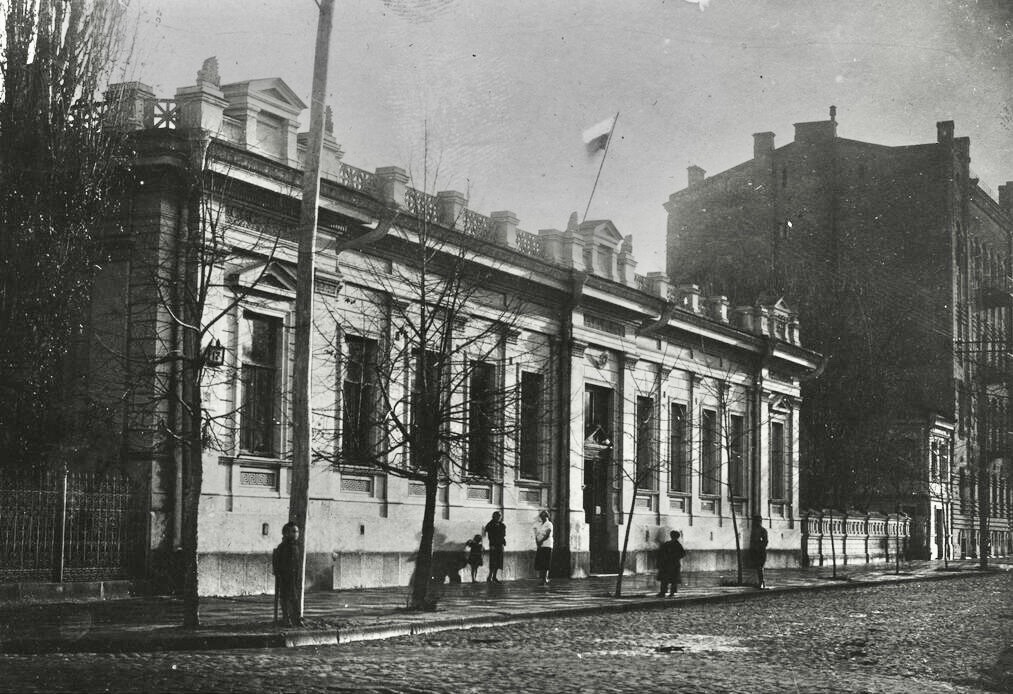
By the time the Soviet Union invaded Poland on 17 September 1939, the Polish diplomatic presence in the USSR consisted of the embassy in Moscow, headed by Ambassador Wacław Grzybowski,[2] and the general consulates in Leningrad, Minsk, and Kyiv. The Polish consulate in Kyiv had opened in 1926 and was housed in a one-story mansion at 1 Karl Liebknecht St. After the transfer of the Ukrainian SSR’s capital from Kharkiv to Kyiv, the mission was elevated to the status of a General Consulate. Starting on 1 August 1934, the Kyiv General Consulate Jan Karszo-Siedlewski;[3] from 1 October 1937 to 1 October 1939, it was headed by Jerzy Matusiński.
Matusiński was born in Warsaw in 1890 and had served in the diplomatic corps since 1926. Before his appointment to Kyiv, he had held posts as Polish Consul General in Pittsburgh, New York, and Lille (France).
The building of the General Consulate at Karl Liebknecht St. was under constant surveillance by NKVD agents. Every visitor to the consulate and all its employees were meticulously recorded by the external monitoring service. As of April 1938, the General Consulate employed thirteen people: the consul-general and vice-consul, clerical staff, cooks, a courier, and so forth. The NKVD maintained an operational file and assigned an operational codename for each consular employee. Vice-Consul Matusiński was given the codename “Lysyi” (“the Bald One”), Vice-Consul Koch – “Pinscher”, while the typist Szyszkowska was known as “Mazurka”.[4]
Diplomatic relations between the USSR and Poland were governed by the Consular Convention signed in Moscow on 18 July 1924, with the exchange of ratification instruments taking place in Warsaw on 1 April 1926. The Convention defined the mutual rights, privileges, and immunities of Consuls General, Consuls, and Vice-Consuls. Articles 4 and 5 of the Convention stated:
ARTICLE 4
Consuls, Consular Secretaries, and Consular Attachés of one of the contracting parties may not be subjected to personal detention on the territory of the other party – whether in administrative order, as a measure of restraint, or in execution of a court sentence, except in the following cases:
Execution of a judicial sentence on the territory of the Union of Soviet Socialist Republics for crimes specified in the articles… [followed by a list of articles from the USSR Criminal Code].
Initiation of criminal proceedings under those same articles of the respective Criminal Codes if the offender is caught in the act.
If a court sentence is imposed on a Consul, Consular Secretary, or Consular Attaché on the basis of articles of the respective Criminal Codes other than those listed in paragraph 1 above, the government of the appointing state must, at the immediate request of the government of the state of assignment, recall the consular official in question.
In all cases of the detention of a Consul or any member of a Consulate, the initiation of criminal proceedings against them, or the issuance of a criminal judgment concerning them, the Government of the state of the Consul’s assignment must immediately inform the Diplomatic Representative of the Consul’s appointing state.
ARTICLE 5
Consuls and consular staff, insofar as they are citizens of the state that appointed the Consul, are not subject to the jurisdiction of the state of their appointment in respect of their official activities.[5]
In the 1939 episode under review, the Polish consul’s immunity was grounded not only in specific treaty provisions but also in the norms of “customary international law” – the body of rules formed by states through general and consistent practice. Historically, diplomatic and consular privileges were endowed with personal inviolability, immunity from criminal jurisdiction, and functional guarantees. These norms had existed as international custom long before they were codified in the 1961 Vienna Convention.
Thus, Soviet and Polish consuls could not be detained without very weighty grounds. On the night of 17 September 1939, the telephone rang at the Polish embassy in Moscow. The call came from the secretariat of Vladimir Potemkin, First Deputy People’s Commissar for Foreign Affairs.[6] Ambassador Grzybowski was urgently requested to come to the Commissariat to receive an important message.
Potemkin read a note to Grzybowski, stating that the Soviet government had ordered the Red Army to cross into Poland and “take under its protection the life and property of the population of Western Ukraine and Western Belarus”. The Soviet note also asserted that the Polish state and government had ceased to exist; consequently, all treaties and agreements between the USSR and Poland were annulled. Grzybowski refused to accept the note and attempted to protest, but there was no way to alter the Soviet leadership’s decision.
From the Soviet perspective, all Polish state institutions and consular establishments on Soviet territory had ceased to exist. Polish consular staff were stripped of their diplomatic immunity. On 17 September 1939, the Polish consulate in Minsk was ransacked, and its personnel interned. The Soviet leadership’s actions toward Polish diplomats were illegal and overtly hostile, but by that point Poland had no means of influencing the situation.
Events at the Polish consulate in Kyiv unfolded in a dramatic manner as well. The approximate chronology of what happened to the staff of the Kyiv Polish consulate has been described in detail by Viktoria Okipniuk, SBU archivist, in her article ‘The Consulate of the Second Polish Republic in Kyiv: The Tragic Epilogue of Autumn 1939’:[7]
By mid-1939, the Kyiv consulate headed by Matusiński employed five contract staff of the Ministry of Foreign Affairs: head of the chancery Ludomir Czerwiński; secretary Antoni Pieńkowski (in reality, Polish intelligence officer Captain Włodzimierz Prosiński); trainee Henryk Słowikowski; Henryk Wiśniewski; and consular secretary Eugeniusz Zarębski (in reality, Major Mieczysław Słowikowski).[8] In late 1939 they were joined by Vice-Consul Józef Zdanowicz (in reality, Captain Jan Kraczkiewicz). The consulate’s drivers were Andrzej Orszyński and Józef Łyczek. Orszyński arrived in Kyiv on 7 October 1936 from Tbilisi, where he had also served as the consulate’s driver. Łyczek had been hired for this position somewhat earlier.[9]
Another relevant work on the fate of Matusiński and his coworkers was written by the historian Ihor Melnikov: ‘How the Bolsheviks Kidnapped the Polish Consul in September 1939’:[10]
On the morning of 17 September, NKVD functionaries entered the premises of the General Consulate of the Republic of Poland in Kyiv and prohibited the staff from leaving the building. On 19 September the Soviet authorities informed the Polish diplomats that they no longer possessed the right to diplomatic immunity.
On 30 September Jerzy Matusiński was summoned to the office of the People’s Commissariat of Foreign Affairs (NKID) in Kyiv and was told that the consulate’s staff must prepare for departure to Moscow. It was at this moment that the consul learned of the fate of the detained ‘Eugeniusz Zarębski’ and Henryk Sławkowski. In the early morning of 1 October, he was again summoned to discuss the details of the Polish consulate staff’s transfer to Moscow. The consul went to the meeting accompanied by drivers Andrzej Orszyński and Józef Łyczek. None of them returned.
The following day, at 6 a.m., the consulate staff sent a horse-drawn carriage to check whether the consul’s car was still parked at the NKID (the Soviet authorities had forbidden them to leave the building). Three hours later, Vice-Consul ‘Józef Zdanowicz’ telephoned the NKID and was told that they knew nothing about the visit or Matusiński’s presence there. Another half hour passed before the consulate received a telephone call: a Soviet official, speaking in a calm voice, informed them that the Polish consul had not been summoned to the NKID.[11]
At 14:00, the previously detained ‘Eugeniusz Zarębski’ and Henryk Sławkowski arrived at the consulate.
On 4 October, the staff of the Polish General Consulate in Kyiv departed for Moscow. On 10 October, the Polish diplomats left the USSR for Finland.[12]
Thus, Jerzy Matusiński disappeared, and there was no information about him until 1941, when the Soviet authorities announced an amnesty for Polish citizens and began to release them en masse from camps and prisons. One of those liberated, Rittmeister Trzaskowski, related that during the evacuation of a Moscow prison to Saratov in 1941, he encountered Andrzej Orszyński, the former driver of Consul Matusiński. According to Orszyński, the passengers in Matusiński’s automobile were arrested near the NKID building in Kyiv, spent eight days in prison, and were then sent by train to Moscow. The train arrived in Moscow on 10 October 1939, after which the detained Poles were taken to Lubyanka, the NKVD internal prison. Orszyński stated that he had seen Matusiński boarding the train in Kyiv on 8 October, and for a long time this date was regarded as the last witness-confirmed moment when Matusiński was known to be alive.[13]
The Law on the Decommunization of Ukraine, which entered into force on 21 May 2015, created an archival revolution of European scale. Thanks to this law, the archives of the state security organs across the entire territory of Ukraine became accessible.[14] The bulk of the documents is held in the Sectoral State Archive of the Security Service of Ukraine in Kyiv. The documents discovered in the archive have made it possible to expand our knowledge of Matusiński’s fate and to learn new details about the operation conducted against him by the NKVD in Kyiv.
The following documents were found in the Sectoral State Archive of the Security Service of Ukraine (HDA SBU):
Collection (fond) 16, inventory (opis') 1, file (sprava) 368: materials concerning the abduction of Matusiński.
Fond 16, op. 1, spr. 481: interrogations of Matusiński by the NKVD.
File 368 contains classified telegraphic reports from the Second Deputy People’s Commissar of Internal Affairs of the NKVD of the Ukrainian SSR, Nikolai Gorlinsky,[15] addressed to the People’s Commissar of the NKVD of the USSR, Lavrentii Beria, dispatched in the early morning of 1 October 1939. From Gorlinsky’s coded messages to Moscow it becomes apparent that at midnight on 30 September 1939, he was summoned to the Central Committee of the Communist Party of Ukraine by the Second Secretary of the Central Committee, Mikhail Burmistenko.[16]
Burmistenko conveyed to Gorlinsky an order from Moscow issued by the First Secretary of the Central Committee of the Communist Party [TsK KP(b)], Nikita Khrushchev, citing a decision of the Politburo of the Central Committee to arrest the former Polish Consul Matusiński. The arrest was to be carried out outside the consulate building. For confirmation and coordination of the arrest, Gorlinsky appealed to Stepan Mamulov, Head of the Secretariat of the NKVD in Moscow.[17] After receiving confirmation from Moscow, the Kyiv security officers arranged to summon Matusiński to the offices of the Commissariat of Foreign Affairs in Kyiv.
Consul Matusiński and his two drivers, Łyczek and Orszyński, were arrested at 2 a.m. on 1 October 1939 by the NKID building. In his coded telegram to Lavrentii Beria, Gorlinsky reported that a total of seventeen employees of the consulate and their family members were inside the consulate building. Gorlinsky was therefore requesting further instructions as to how to deal with these individuals.
The archival file contains a complete list of the participants in the operation: a total of twenty-six people took part or were informed about it. The operation was carried out by the 3rd Department of the Main Directorate of State Security (GUGB) of the Ukrainian SSR NKVD, which was responsible for counterintelligence and operational work against espionage, sabotage, and for the surveillance of foreign citizens and organizations. Next to each participant’s surname in the document, his or her position was indicated: “head of department”, “driver-intelligence officer”, and so forth.
The archival file also contains handwritten non-disclosure agreements from each participant of the operation to abduct the Polish consul. In these agreements, the participants pledged under no circumstances to inform anyone about these activities.
File 481 contains the records of two interrogations of Jerzy Matusiński conducted in Moscow at Lubyanka, the headquarters of the USSR NKVD. One interrogation is dated 22 November 1939, and the other – 9–10 December 1939. The interrogation of 22 November was certainly not Matusiński’s first, since the transcript refers to another interrogation that took place on 13 October 1939. The text of the 13 October interrogation has not been located in the archive. Both interrogations were conducted by a certain Rapoport, Captain of State Security, an officer of the 3rd Department of the GUGB NKVD.
The first interrogation was devoted primarily to Matusiński’s possible contacts with representatives of the Polish General Staff during the consul’s visits to Warsaw. Matusiński’s principal contacts in Poland were officers of the Second Department of the General Staff: Captain Niezbrzycki,[18] Captain Urjasz, Rittmeister Spiciński, and Major Wąkiewicz. Meetings generally took place in the restaurant of the Hotel Bristol.
The intelligence officers were interested in Matusiński’s views on a number of issues that concerned the Polish leadership in 1938–1939: the Sudeten crisis, the concentration of Soviet troops on Poland’s borders, and whether the USSR would act against Germany in the event of war in Europe. During these conversations they also discussed the sentiments of Soviet citizens, as well as prices in Kyiv.
Special attention was given to the questions of surveillance and NKVD control over the staff and visitors of the consulate in Kyiv. In great detail, Matusiński described the strict regime of observation imposed on the consulate: all visitors were detained after leaving the building in order to establish their identity, the reasons for their visit to the consulate, and the nature of the conversations held. In response, Matusiński proposed that equivalent measures be introduced against Soviet consular establishments in Poland.
During questioning, Matusiński was asked by the investigator which Polish intelligence agents he knew. In response, he named four individuals whose names had at some point been communicated to him by Niezbrzycki.[19] Matusiński also stated that, in 1939, intelligence officers attached to the consulate, acting on instructions from the Polish ambassador in Moscow, Grzybowski, repeatedly travelled from Kyiv to various locations for the purpose of verifying and monitoring the movements of Soviet troops. Reports on the results of these inspections were sent to the Political Department of the Polish Ministry of Foreign Affairs and to the Polish Embassy in Moscow.[20]
Examination of the materials from the second interrogation creates the impression that Matusiński did not possess any information of real value that might have interested the investigators. Studying the situation at the borders and the movement of troops was nothing out of the ordinary, and the four individuals Matusiński named as agents did not occupy any special position nor possess a level of access that would have made them of interest to the Polish special services. As for the intelligence officers seconded to the consulate, this was a common practice at that time, and it remains so even today for almost any consular institution of any state.
The second interrogation of Matusiński took place on 9–10 December 1939 at Lubyanka. The main part of the questioning was devoted to the alleged agents in the Ukrainian SSR that were supposedly known to Matusiński. “Alleged” because certain details of the interrogation allow us to presume that the testimony was either extracted from Matusiński under duress or simply added by the investigator.
The very form in which the questions and answers were written in the section of the interrogation dealing with the agents strongly resembles similar passages we have repeatedly encountered in criminal cases of the late 1930s which were later recognized as fabricated.
Here we quote a characteristic section of the interrogation,
Question: Is it your intention to keep insisting that you have communicated everything to the investigation in regards to this matter?
Answer: I have finally decided to cast aside all my hesitations and doubts on this matter and will present everything known to me about Polish intelligence activities in the USSR, in full and without reservation.
Question: You have repeatedly given such assurances to the investigation, and the sincerity of your further conduct will be determined by the veracity of your testimony, the factual side of which will not present any particular difficulty for the investigation to verify…[21]
During this interrogation, Matusiński “recalled” another eighteen individuals allegedly connected with Polish intelligence, in addition to the four he had named at the first interrogation.[22] We believe these to have been Soviet citizens named by Matusiński arbitrarily, under duress. Some of these eighteen individuals were fairly well known. Among those named during the interrogation as “Polish spies” were Adolf Petrovsky, the former plenipotentiary of the NKID in Kyiv, and his deputy Mikhail Yushkevich.
Both had been arrested in 1937 and very quickly sentenced: Petrovsky was executed, while Yushkevich was sentenced to ten years in the camps. After Stalin’s death, both were rehabilitated, and their criminal cases were officially recognized as fabricated. Nevertheless, in the interrogation protocol Matusiński indicated that, according to the previous Polish consul in Kyiv, both had been Polish spies.
Citing the same former consul, Tadeusz Karszo-Siedlewski, the interrogation transcript further listed as Polish spies the People’s Artist of the Ukrainian SSR, soloist of the Kyiv Opera Theatre, Mykhailo Donets, and an actress of the same theatre, Oksana Petrusenko. Also identified as a Polish spy was Petro Franko, the son of the renowned Ukrainian writer Ivan Franko.
Despite the fact that according to Matusiński’s testimony, Donets, Franko, and Petrusenko were all named in the interrogation materials as Polish spies, none of them was arrested in 1939 or 1940. Petrusenko died in 1940 under mysterious circumstances, shortly after being discharged from a maternity hospital. Donets and Franko were arrested in June 1941. For a long time, their fate remained unknown, but in the 2000s a directive was discovered in the Russian State Archive of Socio-Political History (RGASPI) in Moscow, ordering the People’s Commissar of State Security, Vsevolod Merkulov, to execute the arrested “nationalists” Donets and Franko on the instructions of Nikita Khrushchev. Therefore, we can conclude that Donets and Franko were under state security surveillance but were not spies; otherwise, they would have been detained well before 1941.
We can now state with certainty that by 10 December 1939 the former Polish consul, Jerzy Matusiński, was alive and being held in prison in Moscow. According to our information, the criminal case against Matusiński is located in the Central Archive of the FSB in Moscow. However, it remains inaccessible as the case is classified.
The case of the “abduction of Matusiński” clearly demonstrates the importance of the laws adopted by Ukraine aimed at the complete opening of the archives of the Soviet state security organs, which have helped to shed light on the details of the abduction of the Polish consul by NKVD officers in Kyiv in 1939.
Below you can find two blocks of documents: Interrogations of Matusiński: SSA SBU, fond (collection) 16, inventory (opis') 1, file (sprava) 481, fols (ark.) 251–263, 264–92; Documents on the abduction: SSA SBU, f. 16, op. 1, spr. 368, ark. 245–57.
The following notation marks were used when working with the documents:
a…a – the fragment is reproduced exactly as it appears in the original
b…b – handwritten comment
c…c – handwritten correction in the text, note, or fragment inserted
into the sentence
d…d – underlined by hand
e…e – strikethrough or other explicit deletion of a fragment of text
f…f – handwritten signature
g…g – anonymous handwritten signature
h…h – strikethrough in the margins or other markings in the text
i…i – incomplete deciphering
[…] – fragment of text is missing
BIBLIOGRAPHY
SECTORAL STATE ARCHIVE
Security Service of Ukraine (Haluzevyj deržavnyj archiv Služby bezpeky Ukrajiny, hereafter SSA SBU), fond 16, op. 1, spr. 481:
ark. 257
ark. 261–62
ark. 267–68
ark. 269–91
LITERATURE
Ceranka, Przemysław and Krzysztof Szczepanik, Urzędy konsularne Rzeczypospolitej Polskiej 1918–1945 (Warszawa: Ministerstwo Spraw Zagranicznych, 2020)
‘Jerzy Matusiński’, Wikipedia, n.d. <https://pl.wikipedia.org/wiki/Jerzy_Matusi%C5%84ski> [accessed 21 September 2025]
Law of Ukraine ‘On the Condemnation of the Communist and National Socialist (Nazi) Totalitarian Regimes in Ukraine and the Prohibition of Propaganda of Their Symbols’, Vidomosti Verchovnoji Rady, 2015, no. 26, art. 219, art. 5, para. 4
League of Nations, ‘Poland and Union of Socialist Soviet Republics Consular Convention, with two Additional Protocols, and Exchange of Notes relating thereto, signed in Moscow, 18 July 1924’, World Legal Information Institute, p. 205 <https://www.worldlii.org/int/other/LNTSer/1926/139.pdf> [accessed 2 October 2025]
Melnikov, Igor, ‘Kak v sentiabre 1939 goda bolsheviki pokhitili polskogo konsula’, Novaya Polsha, 1 June 2023 <https://novayapolsha.ru/article/kak-v-sentyabre-1939-goda-bolsheviki-pokhitili-polskogo-konsula/?ysclid=mf5tqhj3pi507377903> [accessed 21 September 2025]
Okipniuk, Wiktoria, ‘Konsulat Generalny II Rzeczypospolitej w Kijowie. Tragiczny epilog jesieni 1939 r.’, Przegląd Archiwalny Instytutu Pamięci Narodowej, 9 (2016), 151–64
Olechowski, Piotr, ‘Konsulat Generalny Rzeczypospolitej Polskiej w Kijowie pod lupą radzieckich służb specjalnych w kwietniu 1938 roku’, Przegląd Wschodnioeuropejski, 8.2 (2017), 159–69
[1] ‘Jerzy Matusiński’, Wikipedia, n.d. <https://pl.wikipedia.org/wiki/Jerzy_Matusi%C5%84ski> [accessed 21 September 2025].
[2] Wacław Grzybowski (1887–1959): Polish politician and diplomat, ambassador to the Soviet Union in 1936–1939.
[3] Jan Karszo-Siedlewski (1891–1955): Polish diplomat. He served as a Polish consul in Kyiv from 1 August 1935 to 1 October 1937.
[4] Przemysław Ceranka and Krzysztof Szczepanik, Urzędy konsularne Rzeczypospolitej Polskiej 1918–1945 (Warszawa: Ministerstwo Spraw Zagranicznych, 2020), p. 180; Piotr Olechowski, ‘Konsulat Generalny Rzeczypospolitej Polskiej w Kijowie pod lupą radzieckich służb specjalnych w kwietniu 1938 roku’, Przegląd Wschodnioeuropejski, 8.2 (2017), 159–69 (p. 164).
[5] League of Nations, ‘Poland and Union of Socialist Soviet Republics Consular Convention, with two Additional Protocols, and Exchange of Notes relating thereto, signed in Moscow, 18 July 1924’, World Legal Information Institute, p. 205 <https://www.worldlii.org/int/other/LNTSer/1926/139.pdf> [accessed 2 October 2025].
[6] Vladimir Potemkin (1874–1946): Soviet statesman and party official, historian, educator, and diplomat. First Deputy People’s Commissar for Foreign Affairs (1937–1940).
[7] Wiktoria Okipniuk, ‘Konsulat Generalny II Rzeczypospolitej w Kijowie. Tragiczny epilog jesieni 1939 r.’, Przegląd Archiwalny Instytutu Pamięci Narodowej, 9 (2016), 151–64.
[8] Mieczysław Słowikowski (1896–1989): Lieutenant Colonel of the Polish Armed Forces. In 1937, he entered service in the Second Department of the Polish General Staff, which dealt with intelligence and counterintelligence. In December 1937, Słowikowski was assigned to the Polish General Consulate in Kyiv as a diplomat and head of the Second Department’s intelligence station.
[9] Okipniuk, ‘Konsulat Generalny’, p. 155.
[10] Igor Melnikov, ‘Kak v sentiabre 1939 goda bolsheviki pokhitili polskogo konsula’, Novaya Polsha, 1 June 2023 <https://novayapolsha.ru/article/kak-v-sentyabre-1939-goda-bolsheviki-pokhitili-polskogo-konsula/?ysclid=mf5tqhj3pi507377903> [accessed 21 September 2025].
[11] Melnikov, ‘Kak v sentiabre 1939 goda’.
[12] Ibid.
[13] Okipniuk, ‘Konsulat Generalny’.
[14] Law of Ukraine ‘On the Condemnation of the Communist and National Socialist (Nazi) Totalitarian Regimes in Ukraine and the Prohibition of Propaganda of Their Symbols’, Vidomosti Verchovnoji Rady (VVR), 2015, no. 26, art. 219, art. 5, para. 4.
[15] Nikolai Gorlinsky (1907–1965): Soviet state security officer, Lieutenant General. From December 1938 to July 1940, he served as Second Deputy People’s Commissar of Internal Affairs of the Ukrainian SSR.
[16] Mikhail Burmistenko (1902–1941): Soviet politician. From 1938 to 1941, he served as Second Secretary of the TsK KP(b) of Ukraine.
[17] Stepan Mamulov (1902–1976): Soviet party official and state security officer. From 16 August 1939 to 26 April 1946, he served as the Head of the NKVD and MVD Secretariat.
[18] Jerzy Niezbrzycki (1902–1968): captain of the Polish Army. In 1930–1939, he headed the “East” Section of the Second Department of the Polish General Staff.
[19] Interrogations of Matusiński, Sectoral State Archive of the Security Service of Ukraine (Haluzevyj deržavnyj archiv Služby bezpeky Ukrajiny, hereafter SSA SBU), f. 16, op. 1, spr. 481, ark. 257.
[20] SSA SBU, f. 16, op. 1, spr. 481, ark. 261–2.
[21] SSA SBU, f. 16, op. 1, spr. 481, ark. 267–8.
[22] Ibid., fols 269–91.