

DOCUMENT № 2
Interrogation Protocol of Jerzy Matusiński, 9–10 December 1939
INTERROGATION PROTOCOL[1]
of MATUSIŃSKI, Jerzy Ignatyevich –
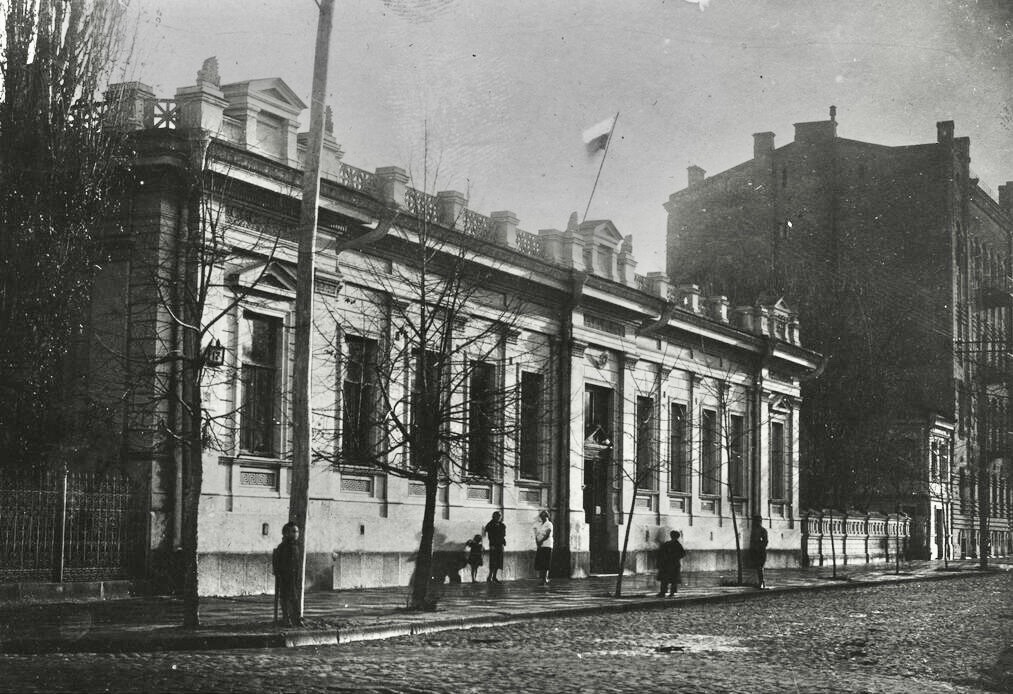
former Counsellor of the Polish Embassy in Moscow, Acting Head of the Polish General Consulate in Kyiv,
dated 9–10 December 1939
Question: In your previous interrogations concerning your meetings with officers of the Second Department of the Polish General Staff in Warsaw, you testified about your meetings and conversations with the following officers of the Second Department: BĄKIEWICZ, NIEZBRZYCKI, STPICZYŃSKI, URJASZ, and another officer of captain’s rank unknown to you.
Were your acquaintances within the Second Department of the Polish General Staff in Warsaw limited to these individuals?
Answer: In my previous testimony, I failed to mention that on the day of my visit to the Second Department of the Polish General Staff, prior to my departure in November 1937 for diplomatic service in Kyiv and after speaking with NIEZBRZYCKI, STPICZYŃSKI, and URJASZ, I went with NIEZBRZYCKI and URJASZ into the office of Colonel PEŁCZYŃSKI,[2] the Head of the Second Department of the Polish General Staff, to whom I was then introduced.
PEŁCZYŃSKI received us standing, thereby signalling the brief nature of the audience. Having learned from NIEZBRZYCKI that I was departing for Soviet Ukraine as Acting Head of the Polish General Consulate in Kyiv, he asked whether I had previously been to Russia. Upon receiving an affirmative reply, he merely wished me success in my work.
I asked PEŁCZYŃSKI to convey my greetings to his wife, Wanda PEŁCZYŃSKA,[3] whom I had previously met in France, in the city of Lille.
The entire conversation with PEŁCZYŃSKI lasted only a few minutes, and thereafter I never met with him again.
Question: Under what circumstances did you become acquainted with Wanda PEŁCZYŃSKA?
Answer: Wanda PEŁCZYŃSKA, a deputy of the Polish Sejm and chairwoman of the Society for Women’s Civil Labor, came to Lille, where I was heading the Polish Consulate, in the summer of 1936. Her visit to France, and to Lille in particular, was connected with the organization of local branches of the Society she led.
In addition, she was interested in the life of the Polish émigré community in France.
On her trip from Paris to Lille, Wanda PEŁCZYŃSKA was accompanied by Regina JĘDRZEJEWICZ, the ex-wife of the former Minister of Education (in 1936, he served as a Commissioner of the Polish Pavilion at the Paris Exhibition), Wacław JĘDRZEJEWICZ.[4]
Regina JĘDRZEJEWICZ worked at the Polish Embassy in Paris, where she was in charge of Polish schools in France.
During Wanda PEŁCZYŃSKA’S two-day stay in Lille, I extended to her all possible assistance and received her at my residence.
Before leaving Lille, she invited me to visit their home in Warsaw.
When meeting her husband, Colonel PEŁCZYŃSKI, at the Second Department, I deliberately conveyed my greetings to his wife, hoping that he would invite me to his home. However, no such invitation followed from aPEŁCZYŃSKI.a I wanted to cultivate a closer acquaintance with PEŁCZYŃSKI for reasons of advancing my career, as the Second Department exercised considerable influence over the entire state apparatus of Poland.
Question: Were there other representatives of the Second Department of the Polish General Staff with whom you were acquainted and maintained contact?
Answer: In late 1936, during a visit to Warsaw, I called on one of the Deputy Heads of the Second Department of the Polish General Staff, Major ENGLICHT,[5] and made his acquaintance at that time.
I asked ENGLICHT to verify the identity of BRATEK KOZŁOWSKI,[6] who headed the Polish Union of Reservists and Former Servicemen in France in the city of Douai (France, Nord département). I asked him to do this using the materials of the Second Department.
I approached ENGLICHT with this request because BRATEK KOZŁOWSKI seemed suspicious to me, since I had received information from members of the Union of Reservists and other Polish organizations in France that KOZŁOWSKI passed himself off as a captain of the Polish Army without actually holding that rank; that he illegally wore the Order of Virtuti Militari;[7] and that he lacked a state licence for medical practice (which he was engaged in).
ENGLICHT promised to check all these issues, and indeed soon sent detailed information to me in Lille about BRATEK KOZŁOWSKI, confirming all the compromising information already in my possession.
As with PEŁCZYŃSKI, I did not meet ENGLICHT again thereafter.
Question: Let us now circle back to the issue of the Polish intelligence network on the territory of the Soviet Union.
Do you continue to maintain that you have already communicated everything on this matter to the investigation?
Answer: I have finally decided to set aside all my hesitations and doubts on this question, and I will present my testimony regarding what is known to me about the Polish agent network in the USSR, fully and up to the last detail.
Question: You have repeatedly given such assurances to the investigation, and the sincerity of your further conduct will be determined by the truthfulness of your testimony, the factual side of which will not present any particular difficulty for the investigation to verify.
Tell us what considerations led you to not provide exhaustive, clear, and precise testimony on the question of the Polish agent network in the USSR.
Answer: What held me back from giving entirely truthful and exhaustive testimony on this matter was solely fear for my own fate. This fear did not stem from the possibility of severe punishment by Soviet justice, but rather from the fear of revenge on the part of members of the former Second Department of the Polish General Staff.
I thought that if, after some time, I were to be released, someone from among the former Polish intelligence officers might kill me as a traitor to his homeland.
I often thought about the fate of the former counsellor of the Polish Embassy in Moscow ZALEZIŃSKI, who died here under strange circumstances in 1931.
His sister, MIROSLAVSKAYA, later told me that ZALEZIŃSKI had been poisoned in Moscow by order of the Second Department of the Polish General Staff for assisting Soviet counterintelligence. Similar rumours circulated in the circles of the Ministry of Foreign Affairs.[8]
Question: Proceed with your testimony concerning the Polish intelligence network in the USSR.
Answer: I am aware of the following agents within the Polish intelligence service who were engaged in espionage on the territory of the USSR:
1. PETROVSKII:[9] former plenipotentiary representative of the People’s Commissariat for Foreign Affairs (NKID) in Kyiv.
During my meeting with my predecessor at the Polish General Consulate in Kyiv, KARSZO-SIEDLEWSKI,[10] at his apartment in Warsaw in October 1937, he informed me that PETROVSKII had supplied him with intelligence information on matters of internal party affairs (party purges, internal factions, particularly bourgeois-nationalist tendencies, etc.), on the situation in government circles (individual transfers and dismissals, the reasons for them, etc.), on arrests, and similar matters.
KARSZO-SIEDLEWSKI did not say anything as to whether PETROVSKII had received monetary compensation from the consulate for his work. However, he noted that PETROVSKII had been his guest on several occasions and had participated in drinking parties at his apartment.
KARSZO-SIEDLEWSKI recommended that, should the opportunity arise, I re-establish contact with PETROVSKII.
During the final months of KARSZO-SIEDLEWSKI’s stay in Kyiv, he had stopped hosting large receptions, and I do not know when precisely his contact with PETROVSKII broke down. When I arrived in Kyiv, PETROVSKII was no longer serving as plenipotentiary of the NKID. I never met him, and thus we never became acquainted.
2. YUSHKEVICH:[11] former deputy plenipotentiary of the NKID in Kyiv.
During that same conversation, KARSZO-SIEDLEWSKI informed me that YUSHKEVICH, like PETROVSKII, had supplied him with espionage information regarding the same matters.
KARSZO-SIEDLEWSKI told me that, as compensation for this work, YUSHKEVICH’s wife received from Warsaw parcels containing fabric, perfumes, stockings, and similar items.
By the time I arrived in Kyiv, YUSHKEVICH, like PETROVSKII, was no longer employed by the NKID, and I did not establish contact with him.
3. DONETS:[12] a performer (singer) in Kyiv.
4. PETRUSENKO:[13] a performer (singer).
During the same conversation, KARSZO-SIEDLEWSKI told me that through the receptions held at the Polish Consulate in Kyiv, he had become acquainted with DONETS and PETRUSENKO, from whom he subsequently received valuable intelligence information concerning Russification in Soviet Ukraine and the attitudes of Ukrainian public circles toward the prospects for national development under the existing regime, as well as the tendencies among those circles toward the creation of an independent Ukrainian state.
KARSZO-SIEDLEWSKI did not share with me whether he extended any material assistance to DONETS or PETRUSENKO.
He recommended that I become acquainted and re-establish contact with DONETS and PETRUSENKO.
However, I met neither DONETS nor PETRUSENKO, as I was unable to arrange receptions in Kyiv.
5. ZAREMBINSKAYA: resided (and possibly still resides) in Kyiv. Approximately 80 years of age. She had two sons: one who served as an engineer in Tbilisi, and another who was a Catholic priest somewhere in central Russia (both died in the early years of the Revolution). Her husband, some kind of a state official, died even before the Revolution. Her husband’s brother lived in Poland but it was not possible to locate him.
ZAREMBINSKAYA received some small allowance from the Social Welfare Office, and for a number of years (up to the fall of 1938, that is, until the moment she ceased visiting the consulate) she received a monthly payment of 50–60 roubles.
She assisted the consulate in locating persons of interest in Kyiv, informed the consulate about affairs at both Roman-Catholic churches in Kyiv, about the mood among the faithful, and, within the limits of her ability, about the population in general.
At the consulate, she maintained contact with Vice-Consul KOCH, with the officer of the Second Department MICHAŁOWSKI, and with me.
During her last visit to the consulate, she complained of feeling unwell. I provided her with some food items and linen, and thereafter she no longer appeared at the consulate.
Later I prepared a parcel for her with food and clothing (sent for her from Warsaw) and intended to have this parcel delivered to her home by the consulate courier MUSIAŁ. The latter, however, advised me against this step, referring to the fact that if he were to visit her apartment, she might get arrested.
6. Olga KURKO: resided (and possibly still resides) in Kyiv. Prior to my departure from Warsaw to my post in Kyiv in November 1937 (or uring my first return from Kyiv to Warsaw in February 1938), the former head of the Polish General Consulate in Kyiv (1933–1934), Piotr KURNICKI,[14] who worked in the Soviet Section of the Third Political Department of the Ministry of Foreign Affairs (P3), informed me that KURKO had served as his liaison agent and located persons he needed to find. KURNICKI said that KURKO would come directly to the consulate to see me. He then handed me 196 roubles to be given to KURKO but provided no explanation regarding this sum.
Besides KURNICKI, prior to my departure to take up the post in Kyiv, I had a meeting in Warsaw with the chairwoman of the Committee for Aid to Those Suffering in the Eastern Borderlands – MARIA SABAŃSKA.[15] She gave me a list with 3–4 names of Polish nationals residing in Soviet Ukraine. These individuals had relatives who lived in Poland. She asked me to locate these individuals. When I told her that doing so would be rather difficult if the search were to be conducted in an official manner through Soviet agencies, SABAŃSKA said that in Kyiv there was a woman, Olga KURKO, who could assist me in this matter.
During my stay in Kyiv, KURKO did not renew her contact with the consulate. I haven’t met with her and did not pass her the money I had received from KURNICKI.
7. Wanda HERBIKH: resides in Kyiv, where she works, if I remember correctly, as an assistant to a doctor (whose surname I have forgotten, but it begins with the letter “G”, possibly Glazunov).
In February 1938, during my trip from Kyiv to Warsaw, KURNICKI invited me to his office at the MID, where Wanda’s sister Celina (or Yelena) HERBICH was already present.
Celina HERBICH told me that in addition to her sister living in Kyiv, their mother also lived near Kyiv. Together with Celina, they had not left the USSR for Poland. This departure did not take place because Wanda had been refused exit permission by the Soviet authorities, and the mother did not want to leave the USSR without Wanda.
Celina HERBICH passed to me a small parcel with warm slippers and chocolate, as well as 40 złoty, to be delivered to Wanda in Kyiv.
After Celina HERBIKH left KURNICKI’s office, he told me the following: during the time of his service in Kyiv, Wanda HERBICH had collaborated with him on intelligence work and, in particular, supplied him with information regarding the mood among the local population, specifically on the questions of nationalist tendencies within the circles of Ukrainian intelligentsia.
KURNICKI mentioned that Wanda HERBICH would be informed if there was a parcel for her at the consulate. She would come for it herself, and during this visit I would be able to renew contact with her.
Wanda HERBICH never came to the consulate in Kyiv to see me, and I was afraid to take the initiative myself to establish contact with her. As a result, I never became acquainted with her.
I knew from the consulate employee CZARWINSKI that after KURNICKI’s departure from Kyiv, Wanda HERBICH continued to visit the consulate and meet with his successor KARSZO-SIEDLEWSKI.
In view of this, I assumed that after KURNICKI, Wanda HERBICH had been connected in intelligence work with KARSZO-SIEDLEWSKI.
8. Petro FRANKO,[16] son of the well-known Ukrainian writer Ivan FRANKO.[17] A chemical engineer residing in Lviv, 2 Obertynska St., apartment no. 9.
In 1936, through the Soviet Consulate in Lviv, Petro FRANKO concluded a contract for employment at the Kharkiv Institutes of Dairy Industry and Applied Chemistry. In the summer of 1937, FRANKO left Kharkiv for vacation in Lviv, and after his time-off ended, he did not receive a re-entry visa to the USSR.
In this connection, FRANKO submitted a number of material claims against the institutes where he had worked under contract, as well as against the Kharkiv publishing house Mystetstvo. His claims against the institutes, for certain inventions and related works, amounted to 85,000 roubles, and against the publishing house (for the portrait of his father, Ivan FRANKO, which he had given them) to 10,000 roubles.
The institutes partially satisfied FRANKO’s claims, paying a sum not exceeding 2,000 roubles, while he received nothing from the publishing house.
I maintained correspondence with the office of the Plenipotentiary of NKID in Moscow in connection to FRANKO’s claims, informing him of this through the Ministry of Foreign Affairs.
FRANKO repeatedly appealed to the MID regarding this matter, and the MID corresponded with me.
In early December 1937, when I received the consular files in connection with the liquidation of the Kharkiv Consulate and the establishment of a single General Consulate in Kyiv from the former Polish Consul in Kharkiv, BRZEZIŃSKI,[18] he informed me regarding Petro FRANKO’s matter.
Brzezinski told me then that FRANKO, being a Ukrainian nationalist, had been establishing illegal contacts in Soviet Ukraine with the local Ukrainian elements, in order to ascertain to what extent the national consciousness there was prepared for the separation of Soviet Ukraine from the Soviet Union with the aim of creating an independent state.
BRZEZIŃSKI also mentioned that during his stay in Kharkiv, FRANKO had acted as BRZEZIŃSKI’s informant on Ukrainian affairs.
Despite this, BRZEZIŃSKI believed that one must exercise particular caution in dealing with FRANKO, since FRANKO adhered to the position of creating a Soborna (United) Ukraine – that is, an independent Ukrainian state encompassing the territories of Soviet Ukraine, Western Ukraine, Subcarpathian Ukraine, and Bukovyna.
In Kharkiv, FRANKO resided with a certain HESBURG, and later (after FRANKO’s departure from the USSR), through diplomatic mail, I received copies of FRANKO’s letters to HESBURG. The tone of the letters was rather warm.
9. TENENWURCEL: an elderly Jewish woman, who resided (possibly still resides) in Kharkiv; she was dependent on her relatives and was formerly a Polish subject. In early 1938, the Soviet authorities brought up the question of returning TENENWURCEL’s Polish passport (previously confiscated by the Polish Consulate in Kharkiv), so that she could subsequently depart from the Soviet Union to Poland.
In the course of clarifying the question of TENENWURCEL’s nationality, I learned from a consulate employee, Ewa SZISZKOWSKA (who had previously worked in Kharkiv), that in Kharkiv, TENENWURCEL had met and maintained contact with Captain KAMIŃSKI, an officer of the Second Department of the Polish General Staff; that he had personally handled the question of her nationality; and as a result of his intervention, the Soviet authorities had annulled the exit visa that had previously been issued to her.
SZISZKOWSKA advised me to resolve the matter of TENENWURCEL only after discussing it with KAMIŃSKI, who by that time was serving in the consular section of the Polish Embassy in Moscow.
Shortly thereafter, when I was in Moscow on official business, I met KAMIŃSKI at the embassy and asked him to update me on the matter of TENENWURCEL.
KAMIŃSKI informed me that TENENWURCEL had been collaborating with him in Kharkiv on intelligence-related work; that, for reasons of expediency, he had arranged for her to remain residing in the USSR by depriving her of Polish citizenship; and that TENENWURCEL herself did not wish to leave the Soviet Union. KAMIŃSKI advised me to insist on refusing to issue a Polish passport to TENENWURCEL and, for the time being, to avoid establishing any contact with her. He did not specify what kind of intelligence information TENENWURCEL had supplied him with.
Following Kamiński’s instructions, I did not issue TENENWURCEL a Polish passport and never made contact with her.
10. Maria PANKOVA-KHOMINA: resides in Kharkiv.
In 1926–1927, she arrived in the Soviet Union as the fiancée of Khomin, who had been released from Polish custody under a special exchange agreement after receiving a ten-year prison sentence in Poland for communist activity.
Khomin was later arrested in the USSR and died either in exile or in a labour camp.
I learned about this from letters written by Maria’s mother, Anastasiya PANKOVA, who resided in Lviv, 12 St. Teresa Street.
Since 1938 and until recently, no less than once a month I would receive letters from Maria PANKOVA’s mother through diplomatic mail.
In these letters, Maria PANKOVA’s mother informed me that her daughter had sympathized with the communist movement only during the time she lived in Poland, when she was engaged to Khomin.
Once in the USSR, however, she had fully adopted the position of Ukrainian nationalism and joined the Ukrainian nationalist movement. Anastasiya PANKOVA asked me to provide her daughter with every possible assistance in arranging her return to Poland and, until her departure, to provide her material support, since she had neither employment nor means of livelihood in Kharkiv.
She further indicated that if I established contact with Maria PANKOVA, I would be able to obtain from her very valuable information about the nationalist movement in Soviet Ukraine. If I failed to do so, her daughter would pass this information to the Polish authorities upon her return to Poland.
Every other month I would send Maria PANKOVA money orders to Kharkiv in the amount of 200–300 roubles. Along with these remittances, I enclosed letters stating that the money was being sent at the request of her mother.
Maria PANKOVA-KHOMINA replied with brief letters acknowledging receipt of the money, expressing gratitude, and asking that her return to Poland be expedited.
To reimburse me for the funds I had remitted to her daughter in Kharkiv, Anastasiya PANKOVA deposited equivalent amounts into the current account that belonged to our consulate, at the postal savings bank in Warsaw.
In late 1938, in one of my letters I asked PANKOVA-KHOMINA to come from Kharkiv to Kyiv in order to meet with me, but she declined, citing poor health. Thus, my meeting with her never took place. The question of restoring her Polish citizenship and her subsequent departure to Poland remains unresolved.
11. I can’t remember her first and last name, and patronymic: a Polish woman, Soviet citizen, with a distinctly Polish last name, a dentist who maintained her own dental office in her apartment in Vinnytsia.
In the summer of 1938, during my trip from Kyiv to Warsaw, I spoke with ZDANOVSKAYA, a secretary of the Administrative Department of the MID, who had previously lived in Russia, where she had owned an estate not far from Vinnytsia.
ZDANOVSKAYA informed me that the woman mentioned above, the dentist, was an old acquaintance of hers. She recommended that I visit her in Vinnytsia and establish contact with her.
ZDANOVSKAYA believed that this woman could assist me in locating several individuals of interest to the consulate, as well as with providing information on specific matters that might concern us. She emphasized that it would be convenient to call on this acquaintance under the pretext of being a patient. Upon my return to Kyiv, I informed MICHAŁOWSKI, an officer of the Second Department, about my conversation with ZDANOVSKAYA.
MICHAŁOWSKI told me that ZDANOVSKAYA’s acquaintance, who lived in Vinnytsia and worked there as a dentist, was known to him, and that she was one of their agents.
In my conversations with both ZDANOVSKAYA and MICHAŁOWSKI, the last name of this dentist was mentioned, but it has since slipped my memory.
12. PERELMAN: resides in Berdychiv, about 17–18 years old. He was studying (and possibly still studies) at a secondary school. He lives together with his younger sister (one year younger than him) at their grandfather’s home. The PERELMAN siblings were brought to Berdychiv in early childhood by their mother, who later returned to Poland (to a small town in Western Ukraine), where she survives on an allowance from a local Jewish community.
In late 1937, a question arose regarding the revocation of Polish citizenship for the PERELMAN brother and sister, in accordance with the new instruction of the MID concerning Polish nationals residing in the USSR.
PERELMAN was summoned to the Polish Consulate, where he had a conversation with MICHAŁOWSKI. Shortly thereafter, when the matter of the PERELMAN case was being discussed, MICHAŁOWSKI told me that he had managed to reach an agreement with PERELMAN and to recruit him as an agent. Due to the minor age of the PERELMAN siblings, there were no legal grounds for depriving them of Polish citizenship; moreover, there were no indications that the Soviet authorities intended to raise the issue of their departure for Poland. Therefore, their Polish passports were not confiscated.
I do not know how contact was subsequently maintained with the recruited PERELMAN.
[…]
After HNATYSHAK had done this, it turned out that the ticket was sold only as far as Zdolbuniv, and being without funds, she did not know how to proceed from Zdolbuniv to Lviv. I reassured her that I would arrange for her travel from Zdolbuniv to Lviv. The remaining 30 roubles she had were transferred to the account of the Polish Consulate General in Kyiv; subsequently, this amount was remitted to her by the MID to her location in Lviv.
While traveling from Shepetivka to Zdolbuniv in the same compartment with HNATYSHAK, and once we crossed the border, without letting her understand that I was aware of her intelligence work for Poland, I started a conversation with her about the Ukrainian nationalist movement in Soviet Ukraine. I asked HNATYSHAK whether she could discern any tendencies toward the creation of an independent Ukrainian state in the circles of Ukrainian intelligentsia and youth. She replied that, in her personal opinion, Ukraine had not yet matured for independence, and that its fate was to remain under the rule of either Poland or Russia. She described the youth as apolitical, preoccupied with material and economic concerns, and not engaging with the question of Ukraine’s “self-determination”.
At the Zdolbuniv station, HNATYSHAK was met by a representative of the Polish Red Cross station, and I never saw her again.
14. STANKIEWICZ: an elderly Pole, citizen of the USSR, formerly a bailiff residing in Vinnytsia. His brother lives in former Poland, where he serves as a mid-level government official in one of the voivodeships (probably in Kielce).
In 1938, STANKIEWICZ submitted a petition to the Soviet authorities requesting the issuance of a foreign passport to travel to Poland to visit his brother. He asked the consulate, in the event that he received such a passport, to secure an entry visa for him, explaining that if he were able to enter Poland, he would not return to the Soviet Union and would petition the Polish authorities for the restoration of his Polish citizenship.
Stankiewicz came to the consulate, it seems, twice, but I saw him there only once, in the spring of 1939 (in May, of course).
At the request of STANKIEWICZ’s brother, who lived in former Poland, I provided STANKIEWICZ with modest financial assistance consisting of two postal transfers of 100 roubles each.
During his visit to the consulate in the spring of 1939, STANKIEWICZ spoke with ZARĘBSKI, an officer of the Second Department, who personally handed him an additional sum of money.
After this conversation with STANKIEWICZ, ZARĘBSKI told me that STANKIEWICZ had given him some information of interest and hinted that he (ZARĘBSKI) had recruited him for further work.
The question of STANKIEWICZ’s departure to Poland remains unresolved.
15. PONIATOWSKI: an elderly Pole, citizen of the USSR, a veterinary assistant residing in Tiraspol.
He appeared at the consulate during the same period as STANKIEWICZ (around May 1939) to inquire about the possibility of leaving the USSR for Poland.
Before coming to the consulate, PONIATOWSKI had written to me about his difficult financial situation and had asked me to contact his relatives living in the former Wilno voivodeship to find out whether they would be willing to take him into their care.
The response from his relatives was negative, and together with the letter informing of this, I sent him 100 roubles by post.
When PONIATOWSKI came to the consulate, he immediately sat down to write letters to his relatives, and I exchanged only a few words with him in the reception room.
[…]
Before his arrest, ŻENSIKOWSKI had been involved in espionage activity, maintaining contact with the Polish Consul in Kyiv, to which he provided information regarding collective farm construction and the mood of the collective farmers.
During the investigation of his case, he said nothing about this activity. After his release from the labour camp, he returned to his family in the Kovali collective farm.
ŻENSIKOWSKI asked me to arrange for his departure to Poland.
Since ŻENSIKOWSKI’s case was held at the Polish Embassy in Moscow, I promised him that I would send an inquiry to the embassy, then contact the Soviet authorities, and inform him of the results.
At the same time, I asked ŻENSIKOWSKI whether he would agree, pending a decision on his departure to Poland, to resume informing for the consulate.
Without any hesitation, ŻENSIKOWSKI gave his consent. I then advised him to return to Kovali, live there quietly, and informed him that he would receive instructions for his work from the consulate during his next visit (once we had summoned him).
The question of payment for ŻENSIKOWSKI’s work was not raised, but I gave him a one-time payment of 100 roubles.
When ZARĘBSKI (he returned to Kyiv a couple of days later) learned about my conversation with ŻENSIKOWSKI, he was pleased and took the entire matter into his own hands.
At that time, I requested ŻENSIKOWSKI’s case from Moscow; I received it about three weeks later. The information contained in the dossier fully corresponded to the biographical data provided by ŻENSIKOWSKI himself and made it possible to raise the question of recognizing his right to Polish citizenship.
However, ŻENSIKOWSKI did not receive a Polish passport.
Around mid-July 1939, ŻENSIKOWSKI received a letter from the consulate, requesting that he come to the consulate to process his passport application.
In order not to attract attention of the Soviet authorities to this matter, the letter stated that ŻENSIKOWSKI should either come to Kyiv personally or send his photograph.
ŻENSIKOWSKI did not appear at the consulate and did not respond to our letter.
17. Anton KOSTETSKYI: Ukrainian, former Austrian subject residing in Cherkasy. He was born in a village near the town of Terebovlia (Western Ukraine), where his entire family still lives, except for his sister (married name MAKARCHUK), who lives in the United States, in New Jersey (near New York), where she and her husband own an inn.
In 1926, KOSTETSKYI, fleeing military conscription and repression for his involvement in the communist movement in Western Ukraine, escaped from Poland to Austria, where he studied for two years at the medical faculty of the University of Graz.
While in Austria, KOSTETSKYI joined the Communist Party and was subsequently expelled from the country.
After his expulsion from Austria, he lived for some time in Germany. In 1930, with the assistance of the International Red Aid (MOPR),[19] he arrived in the USSR.
While in the Soviet Union, KOSTETSKYI resided in Kyiv, where he first studied at the medical faculty of the local university and then, around 1932, joined the Kyiv Film Studio.
In 1933, KOSTETSKYI was arrested in Kyiv on charges of belonging to a Ukrainian nationalist organization and was sentenced to five years’ imprisonment in the Solovki prison.
In January 1939, KOSTETSKYI was released from prison and arrived in Moscow, where he appeared at the Consular Department of the Polish Embassy, requesting assistance in returning to Poland.
Although KOSTETSKYI’s “dossier” was kept at the Polish Embassy, he was given no definitive answer there.
Immediately after leaving the embassy building, KOSTETSKYI was detained by representatives of the Soviet authorities, who instructed him to proceed to Kyiv.
Upon arrival in Kyiv, KOSTETSKYI came directly to me at the consulate, recounted all of this, repeated his request for assistance with leaving for Poland, and asked that I contact his sister living in New Jersey to arrange financial assistance and to inquire about the possibility of emigrating to the United States (should his departure to Poland be denied).
I promised KOSTETSKYI that I would inquire about him at the embassy, write to his sister, communicate with the local Polish authorities, and asked him to return in two weeks for the results.
At the same time, as a form of financial support, I gave KOSTETSKYI 80 roubles, for which I received a written receipt.
The “dossier” on KOSTETSKYI that arrived from the embassy and the reply from the local Polish authorities (to my inquiry) confirmed the biographical details he had provided. However, it turned out that after his flight from Poland, KOSTETSKYI’s Polish citizenship was annulled, making his return virtually impossible.
During one of his subsequent visits to the consulate, I informed KOSTETSKYI of this fact, but he continued to come and insist on obtaining permission to leave for Poland. During his third visit, KOSTETSKYI told me that he had been detained by the NKVD, where he had been advised to abandon the idea of emigrating to Poland and was promised employment.
I advised KOSTETSKYI to accept this offer and told him that if he were later able to re-establish contact with Ukrainian nationalist organizations, he might be useful to the Polish consulate for intelligence work.
KOSTETSKYI agreed to this proposal in principle but still asked that his case for return to Poland continue to be presented to the Polish authorities.
Through the Polish Consulate in New York, KOSTETSKYI’s sister sent her brother a letter and 25 U.S. dollars.
The letter and money were sent by his sister following my inquiry about her to the Polish Consul General in New York, who had summoned her to the consulate.
In total, I issued 650 roubles to KOSTETSKYI over a period of time. Until May 1939, KOSTETSKYI lived in Kyiv without registration or fixed residence, spending most nights at railway stations.
In May 1939, he was forcibly settled in Cherkasy.
In June 1939, KOSTETSKYI came from Cherkasy to Kyiv for the last time to visit the consulate. He said that he still had no employment and requested the issuance of a Polish passport with permission to depart for the United States.
Through me, he sent his sister a letter asking her to petition the American authorities for a visa allowing him entry to the United States.
During KOSTETSKYI’s last visit to the consulate, he was also interviewed privately by ZARĘBSKI, who, as usual, was interested in questions related to the local military garrison.
18. KARPOVICH: approximately 13 years old, Belorussian. His father had been arrested several years earlier; his mother had been deported, after which he was placed in the Ovruch orphanage.
In July 1939, KARPOVICH came to the consulate, saying that he had run away from the orphanage after being accused of stealing linen. KARPOVICH explained that he had come to the consulate because he had once visited it with his mother, who had petitioned for permission to leave for Poland, where they had relatives in Western Belorussia.
In the course of the conversation, KARPOVICH also mentioned that while living in the Ovruch orphanage he had played in the orchestra of a military regiment stationed there.
When asked whether he wanted to go to Poland, KARPOVICH replied in the negative, explaining that he did not know the whereabouts of his relatives.
When I asked him what he wanted, KARPOVICH replied: “Just a bit of money”.
Although an immediate check of the consular card index did not confirm the fact that KARPOVICH’s mother had previously visited the consulate, I ordered that he be fed at the consulate, and, after giving him 30 roubles, advised him to return to the orphanage.
Two or three weeks later, KARPOVICH unexpectedly appeared at the consulate again, saying that he had run away from the orphanage once more but was planning to return there and was asking for money for a ticket and travel expenses to Ovruch.
Since KARPOVICH struck me as a very intelligent and capable boy, I immediately referred him to ZARĘBSKI for further conversation.
ZARĘBSKI recruited KARPOVICH on a trial basis, and after providing him with money for the ticket and travel, gave him an assignment to gather information on the military units stationed in the Ovruch area.
Description of KARPOVICH: short in stature, slender build, dirty blond cropped hair.
Regarding the intelligence agents NIEZBRZYCKI mentioned to me, ZAWADZKI, HNATYSHAK (male), KSIĘŻOPOLSKI, and GOLDBERG (or GOLDMAN), about whom I testified during the interrogation of 22 November 1939, I find it necessary to clarify the following:
a) I might have remembered the last name “ZAWADZKI” incorrectly. It is possible that the name was ZALEWSKI or ZAKRZEWSKI. In Anopol, there lived a Polish property owner with one of these three last names; he departed for Poland in 1938.
b) As for HNATYSHAK, NIEZBRZYCKI referred either to Minodora HNATYSHAK’s husband (later deceased) or to Minodora HNATYSHAK herself, known to me as being involved in intelligence work under MICHAŁOWSKI’s direction.
c) I am not entirely certain that KSIĘŻOPOLSKI resides in Vinnytsia. Incidentally, in an old report from 1936 by my predecessor at the Kyiv consulate, KARSZO-SIEDLEWSKI, it was noted that he had issued financial assistance to KSIĘŻOPOLSKI in the amount of 200 roubles.
d) I may also be mistaken in stating that GOLDBERG (or GOLDMAN) resides in Berdychiv. In that same report by KARSZO-SIEDLEWSKI, it was recorded that this individual had received financial assistance of 150 roubles from him.
Apart from the persons I have already listed, I am aware of the former involvement in Polish intelligence of several others:
BINENFELD, doctor of chemistry from Konstantinovka;
VERBER, doctor from Kharkiv;
BIBIKA;
IVINSKII, worker from the Donbas;
KWAŚNIEWSKI and SHENFELD, Catholic priests from Kyiv;
HORCHINSKII, Catholic priest from Kharkiv;
Ilya PAWLIAK, from Kyiv.
All these people were, at various times between 1937 and 1938, arrested by the NKVD.
Only one of those arrested, namely PAWLIAK, was expelled to Poland in 1938.
Question: You will be interrogated further regarding these arrests and a number of other matters.
MATUSIŃSKI: I wish to make the following statements:
1. In May 1937 (shortly before his arrest), the Kyiv priest KWAŚNIEWSKI left information at the consulate stating that in the old Catholic church of St. Alexander, under the wooden floor of the choir loft on the left side of the organ, a cache had been hidden containing valuable silver liturgical objects. After KWAŚNIEWSKI’s arrest, no new priest was appointed; the faithful gathered in the church on their own, and later the church was closed.
2. During the liquidation of the Polish Consulate General in Kyiv, Officer of the Second Department, ZDANOWICZ, gave instructions to bury in the earthen floor of the cellar several cameras and photographic equipment, in particular a photographic apparatus for reproducing documents. All these items were buried. However, later on ZDANOWICZ hesitated, considering whether to unearth the items in order to take them with him out of the USSR. Whether ZDANOWICZ retrieved this equipment from the cellar or not in the end is unknown to me.
This testimony has been accurately recorded from my words, read and signed by me: (MATUSIŃSKI)
INTERROGATED BY:
HEAD OF THE FIFTH SECTION, THIRD DEPARTMENT, MAIN DIRECTORATE OF STATE SECURITY, NKVD USSR CAPTAIN OF STATE SECURITY:
(Rapoport)
[Seal]
SSA SBU, f. 16, op. 1, spr. 481, ark. 264–95.
[1] The interrogation protocol is missing pages 282 and 286.
[2] Tadeusz Pełczyński (1892–1985): Polish military officer and head of military intelligence. During the interwar period, he served as Chief of the Second Department of the General Staff of the Polish Armed Forces, where he was responsible for the organization and coordination of Polish intelligence networks abroad, including those operating on the Eastern Front. During the Second World War, he was one of the organizers of the Armia Krajowa (Home Army) intelligence service, overseeing both intelligence and counterintelligence operations within the Polish underground.
[3] Wanda Pełczyńska (1894–1976): Polish independence activist, publicist, and member of Sejm (4th term, 1935–1938). During the Second World War, she served as a courier and underground operative, working for the Information and Propaganda Bureau of Armia Krajowa. After the war, she emigrated to the United Kingdom.
[4] Wacław Jędrzejewicz (1893–1993): Polish officer and politician of the Sanation movement (from Polish sanacja: healing), Head of the “Eastern” Section of the intelligence service of the Second Department of the General Staff. In 1934–1935, he served as Minister of Education. After the war, he emigrated to the United States, where he became co-founder of the Józef Piłsudski Institute in New York.
[5] Józef Englicht (1891–1954): Polish military officer and intelligence operative, one of the key organizers of Poland’s interwar intelligence service. He headed the “Russia” Section Within the Second Department of the General Staff. In 1939, he became Deputy Chief of the Second Department. He oversaw intelligence operations against the USSR and the coordination of eastern intelligence outposts. After 1939, Englicht lived in exile, serving as an officer of the Polish Armed Forces in France and the United Kingdom, and later as editor of the military journal Bellona in London.
[6] Franciszek Witold Bratek-Kozłowski (1900–1988): Polish physician and military officer, participant in the Polish-Soviet Wars (1918–1921). After studying in Kraków and Paris, he specialized in surgery and urology. While in France, he organized a network of Polish veterans’ associations. During the Second World War, he served as a military surgeon, and from 1942 was stationed in Canada, where he rose to the rank of major. After the war, he worked as a surgeon and community leader within the Polish diaspora in Montreal.
[7] The Order of Virtuti Militari (Order of Military Virtue) is Poland’s highest military decoration for valour in the face of the enemy, established in 1792 by King Stanisław August Poniatowski. It is one of the world’s oldest military decorations still in use, awarded to both individuals and military units for acts of outstanding bravery on the battlefield.
[8] Any information confirming this event or even mentioning Zaleziński is missing in both historical and scientific sources.
[9] Adolf Markovich Petrovskii (1887–1937): Soviet diplomat, plenipotentiary representative of the USSR in Estonia, Lithuania, Persia, Austria, and Hungary. Starting December 1934, he served as Authorized Representative of the USSR People’s Commissariat for Foreign Affairs in the Ukrainian SSR. Petrovskii was arrested in 1937 during the Great Purge and subsequently executed.
[10] Jan Karszo-Siedlewski (1891–1955): Polish diplomat and consular official. He served as Consul General in Kharkiv and Kyiv. Starting 1938, he was as Envoy Extraordinary and Minister Plenipotentiary of Poland to Iran and Iraq. Between 1935 and 1937, he headed the Polish military intelligence outpost in Kyiv, maintaining close cooperation with Poland’s intelligence services.
[11] Mikhail Yushkevich (1882–?): Deputy Representative of the USSR People’s Commissariat for Foreign Affairs (NKID) in Kyiv. On 18 October 1937, he was sentenced to ten years in a corrective labour camp (Russian: ispravitel’no-trudovoi lager’, ITL).
[12] Mykhailo Ivanovych Donets (1883–1941): Ukrainian Soviet opera singer, People’s Artist of the Ukrainian SSR. He was arrested by the NKVD and died in prison in 1941.
[13] Oksana Andriyivna Petrusenko (1900–1940): Ukrainian opera singer, People’s Artist of the Ukrainian SSR (1939). She performed in theatres in Kherson, Kyiv, and other cities.
[14] Piotr Kurnicki (1899–1975): Polish diplomat and consular official, former consul in Khust, secretary of the Polish Embassy in Bratislava, and consul in Zagreb. He also served as an agent of the Polish intelligence service (residency “Ku”) in Kyiv, where he documented and reported on the Holodomor.
[15] Likely, Maria Zofia Teodozja Sobańska (1865–1951): Polish social and philanthropic activist, organizer of literary salons in Warsaw. She served as vice-chairwoman of the Warsaw branch of the National Women’s Organization.
[16] Petro Franko (1890–1941): Ukrainian educator, chemist, ethnographer, and public figure, son of Ivan Franko. He was a member of the Plast movement, a captain of the Ukrainian Sich Riflemen, an inventor, and a deputy of the Supreme Soviet of the Ukrainian SSR. Arrested by the NKVD in 1941. Competing accounts persist regarding the manner and place of his death in July 1941. Some state he was killed while being transported near Proshova (Ternopil) amid the NKVD evacuations and shootings at the war’s outset; others hold that he was executed by NKVD operatives in Kyiv. Newly cited archival material includes a ciphered NKVD/NKGB telegram of 6 July 1941 from Kyiv to Moscow, reporting that, “by order of Comrade Khrushchev”, Petro Franko, Kyrylo Studynsky, and artist Mykhailo Donets had been arrested and – since evacuation was difficult – “it is considered expedient to shoot them”, a proposal approved “for” at the centre (Beria, Molotov, likely Malenkov). A 1969 KGB summary later concluded Franko had been shot without trial in 1941; nonetheless, the exact circumstances remain uncertain.
[17] Ivan Franko (1856–1916): major figure in Ukrainian literature and thought: poet, novelist, dramatist, critic, publicist, folklorist, and social philosopher. Often called the “second great awakener” after Taras Shevchenko, Franko helped to shape the modern Ukrainian literary language and national consciousness. His works, written in both Ukrainian and Polish, combine realism with strong ethical and social engagement, articulating the intellectual foundations of Ukrainian modernity.
[18] Tadeusz Brzeziński (1896–1990): Polish diplomat and consular official. He served in various diplomatic and consular posts (Essen, Lille, Leipzig, Kharkiv). Starting 1938, he was Consul General in Montreal. After the Second World War, he remained in Canada, becoming an active figure in the Polish émigré community.
[19] MOPR (Mezhdunarodnaya organizatsiia pomoshchi bortsam revoliutsii – International Organization for Aid to Revolution Fighters) was a Soviet-sponsored international organization founded in 1922 under the auspices of the Communist International (Comintern). Its purpose was to provide political, legal, and material assistance to communists and other leftist activists imprisoned or persecuted abroad. Often described as a “Red Cross of the Revolution”, MOPR functioned as both a relief agency and a tool of Soviet soft power, maintaining branches in many countries until its dissolution in the late 1940s.