
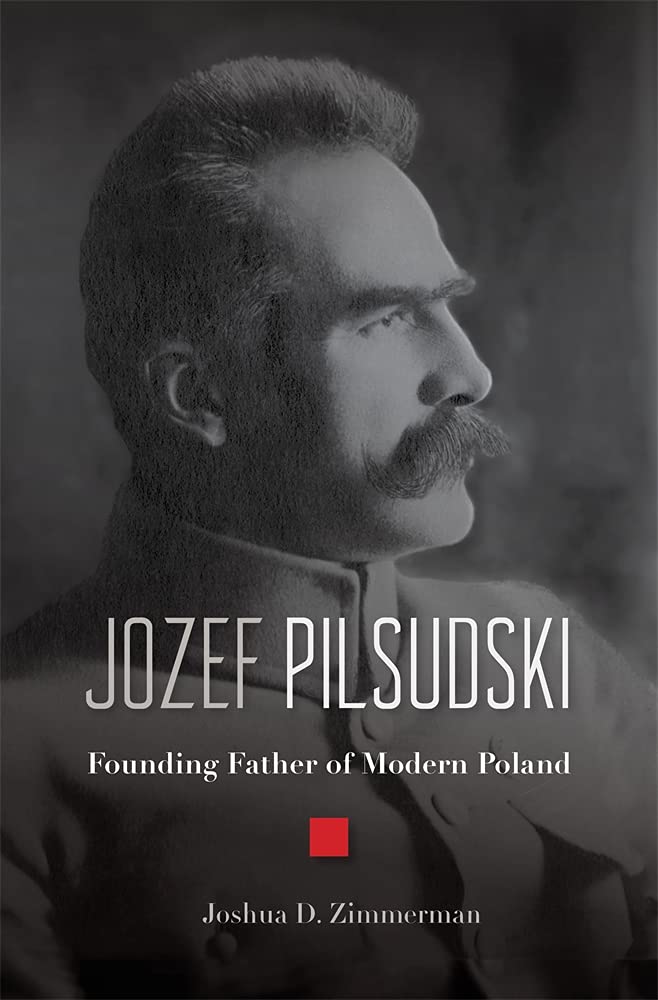

Józef Piłsudski is undoubtedly one of the most important figures of twentieth-century Polish history, but he inspired disparate attitudes in his lifetime: he was both revered and despised. Today, however, he commands a place in the pantheon of the greatest Polish heroes. So, it is no surprise that he has also become the hero of the works of numerous Polish historians, including Wacław Jędrzejewicz, Andrzej Garlicki, Daria and Tomasz Nałęcz, and Włodzimierz Suleja.[1]
Joshua D. Zimmerman’s book is the first scholarly biography written by a non-Pole. The author rightly notes the incomprehensible lack of studies on or interest in Piłsudski outside of Poland – this fact alone makes his book notable. Similarly important is the prestigious publishing house involved. The author himself is a graduate of the University of California and was awarded his doctorate at Brandeis University. A long-time professor of history at Yeshiva University, Zimmerman has to his name works on the history of Polish Jews and Polish-Jewish relations, including on the Polish underground’s approach to Jews during the Second World War,[2] the relationship between the Bund and Polish socialists,[3] as well as Jews in fascist Italy.[4] Many years ago, he attempted to present Piłsudski’s attitude to the Jewish question.[5] This biography offers a comprehensive portrait of the same figure. While the author’s book on the Polish underground and the Jews was generally well received around the world,[6] in Poland it was somewhat controversial.[7] In contrast, his biography of Piłsudski has so far received positive reviews.[8]
The book’s title demonstrates the author’s intention to present his subject above all as the founder of Polish statehood. In the introduction, however, he declares a desire to address Piłsudski’s “dual legacy”: on the one hand, he was the founder and champion of the Polish state, laying the foundations of Polish democracy and defending tolerance and national minorities; on the other, he is the black legend of the imposition of authoritarian rule on Poland after 1926.
The biography is divided into 18 chapters, as well as an introduction, epilogue and index. It is richly illustrated with photographs, maps, and diagrams, which provide the reader with a better understanding of the contents. It is just a pity that there is no bibliography. The sources the author uses are predominantly Piłsudski’s own writings as well as the memoirs of his friends, colleagues and contemporaries. Zimmerman also makes use of archival materials collected at the Piłsudski institutes in London and New York, as well as, to a modest extent, the Archives of Modern History Documentation in Warsaw. Polish readers, especially those familiar with Piłsudski’s biography, are unlikely to find any new sources here that depict the marshal in a new light or reveal unknown details about his life. Something of note that the author does offer, however, is views quoted from the Western, particularly American, press, not just on Piłsudski himself, but also about the events taking place at the time in Poland. Also valuable are the accounts of Western politicians who met the Polish leader, thus showing how he was perceived in the Western world. As well as works in English, the author also uses a large amount of literature in Polish, with which he is undoubtedly well acquainted, especially older books. His knowledge of newer literature on the subject is less complete. There is no mention of the works of Waldemar Paruch and Grzegorz Nowik, for example.[9]
At the centre of the author’s interests lies, of course, Józef Piłsudski, but he sketches the context in which he operated quite broadly, including the great powers’ approach to the Polish question during the First World War. This provides Western readers unfamiliar with Polish history with a better understanding of the protagonist. Zimmerman portrays Piłsudski as a conspirator, leader, and statesman, but he also describes his complex emotional and private life. Above all, he gives a voice to his subject. We get to know Piłsudski chiefly through the many quotations from his own statements and publications, as well as accounts, recollections, and opinions about the man from the people around him. Zimmerman seems less interested in Piłsudski’s political ideas, which is not to say that he omits them. He also makes relatively little use of the views of previous biographers or other scholars.
The period covered at the greatest length in the book is that of Piłsudski’s conspiratorial activity in the Polish Socialist Party. Five chapters are devoted to these 12 years (1892–1904), whereas Piłsudski’s rule following the May Coup receives only three. The reason for this may be the author’s particular interest in the earlier period, which he researched for his aforementioned book on the relations between Polish and Jewish socialists. An interesting and scarcely known topic is Piłsudski’s attempts to collaborate with Lithuanian and Jewish socialists. Zimmerman also devotes a comparatively large amount of space to Piłsudski’s approach to Jews, especially his efforts to win the Jewish community over to the idea of Polish independence by publishing in Yiddish. The author highlights the presence of people of Jewish origin in his subject’s circle and the socialist leadership – Stanisław Mendelsohn being one example. He addresses similar issues later in the book too: for example, the postwar pogroms of Jews and Piłsudski’s reaction (pp. 295–300), and the internment of Jewish soldiers at a camp in Jabłonna (pp. 364–68). Generally, Zimmerman emphasises Piłsudski’s tolerance and positive attitude towards Jews [although he sometimes uses the diminutive Żydki (approximately: “little Jews”)]. Fortunately, however, the Jewish themes in the book are not dominant and do not overshadow others. They are also certainly interesting for Polish readers, as previous biographies have tended to overlook these issues somewhat.
In keeping with the title, Zimmerman writes at length on Piłsudski’s activities as Poland’s Chief of State and his role in building the Second Polish Republic, particularly in border struggles. The author rightly cites this as his subject’s greatest contribution. He notes that despite inheriting practically absolute power in November 1918, especially until the election of the Legislative Sejm the following year, Piłsudski did not exploit this for his own objectives. He decided to build a democratic, pluralist state. Quoting the words of Maxime Weygand, Zimmerman indirectly supports the view that it was Piłsudski who was behind the victorious Wieprz counteroffensive (pp. 368–69). However, he overlooks the fact that the Polish command had cracked the Bolsheviks’ cipher and was therefore aware of their intentions, as Grzegorz Nowik wrote some time ago.[10]
The final chapters on the May Coup and the subsequent government are something of a disappointment. The author does not actually describe the Sanacja government, confining himself to basic information about the August Novelisation and the formation of the Non-party Bloc for the Support of the Government. Of course, the book also addresses the conflict with the left and People’s Party, and the emergence of Centrolew (the centre-left coalition), but it focuses less on the rise of authoritarian tendencies. The author recognises that the constitution adopted in April 1935, which gave the president vast power, was an element of Piłsudski’s wider programme for Poland, which he had been developing since the early 1920s – the culmination of years of reflection on the need to strengthen the executive. In a sense, however, Zimmerman also excuses Piłsudski, quoting Antony Polonsky in noting that he criticised the tricks employed when parliament adopted the constitution (a reference to the voting on the so-called constitutional theses).
Zimmerman covers Piłsudski’s foreign policy and relations with Germany and the Soviet Union at more length, including the non-aggression pacts with these two neighbouring countries. He discusses the issue of the so-called ‘preventive’ war in detail. For the author, the German-Polish declaration of non-aggression of 26 January 1934 was a significant achievement for Piłsudski as it was the culmination of his policy pursued in 1932–1934, namely the gradual departure from dependence on France towards balanced relations with Germany and Russia. Zimmerman cites the approving references to the agreement that were expressed in such newspapers as The Observer, The New York Times, and Le Temps (pp. 461–63). In his view, with this move Piłsudski “had achieved international calm and security, temporarily suspending any chance of compromising his country’s security” (p. 469). Furthermore, he had strengthened Poland’s status in the eyes of the Western powers, demonstrating to them that any disturbance of the border guarantees would lead Poland to do whatever was necessary to ensure its security. The author also notes, however, that Piłsudski was a pessimist regarding Poland’s further prospects and wondered aloud to those he trusted which of the country’s neighbours would be the first to strike.
On Piłsudski’s death, Zimmerman underlines that the whole Jewish community in fact united in grieving for him. Jews saw him as their defender, the author notes, and the wave of violence against Jews was only unleashed after his death (pp. 483–85). He also points out that Poland lacked capable heirs to the marshal’s legacy. Józef Beck, the foreign minister, was unable to navigate the country through the crises stacking up in the international arena, steering a pro-German course in the questionable belief that the January declaration would guarantee Poland a longer peace (pp. 485–87) (although his attitude to the Anschluss with Austria or the Czechoslovak crisis raises valid objections).[11]
The author generally confines himself to presenting his subject’s biography, showing less interest in his political ideas. He omits, for example, the concept of Prometheanism, which is associated with Piłsudski, or the “imperial thought” developed by his supporters. He also fails to address at length issues that caused the most controversy in his subject’s biography, such as his stance on federalist ideas. Many scholars have major doubts regarding the perception of Piłsudski as a federalist – citing the widely known assertions from his letter to Leon Wasilewski of April 1919 – as did those who worked with him, such as Michał Romer, a member of the Polish Legions. Nor does the author specify the shape of the planned federation – for instance whether it would only encompass Belarus and Lithuania, or also Ukraine.[12] Moreover, when discussing Piłsudski’s minority policy, he does not mention the so-called “Volhynia Experiment”.
As is often the case with biographers, Zimmerman goes easy on his subject, although he does not conceal his more controversial manoeuvres and actions. Perhaps it is for this reason, however, that he is sparing in his description of the Brest arrests and the torture, trials and sentencing of those imprisoned in the Brest Fortress, including individuals once ideologically close to Piłsudski, such as the socialist Herman Lieberman. He does, however, point out that the Brest affair had a major impact on the evaluation of the last years of Piłsudski’s rule, citing the views of the Western press. However, there is no mention of the still-unexplained fate of General Włodzimierz Zagórski or the beatings of people critical of Piłsudski, such as Tadeusz Dołęga-Mostowicz and Adolf Nowaczyński. Zimmerman also omits his subject’s role in the pacification of Eastern Galicia (p. 425), although the marshal personally ordered the minister of internal affairs, Felicjan Sławoj Składkowski, to carry it out.[13] There is a general lack of criticism of the system created by Piłsudski after 1926 – for which he bore full responsibility – which was based on military men, many of whom did not have appropriate competences, and Piłsudski surrounded himself with followers and supporters rather than people willing to oppose him, etc. Zimmerman is not interested in the cult of the marshal which formed in Piłsudski’s lifetime – encouraged by the man himself – although he does highlight the meetings of the members of the Polish Legions.
In his conclusions, Zimmerman addresses Piłsudski’s greatness and merits for Poland and his place in Poles’ collective memory. He also emphasises the accuracy of his predictions regarding the threats from Germany and the Soviet Union. Zimmerman sees Piłsudski generally as a democrat who, after years of chaos and changing governments, believed that the Poles were not ready for democracy. In his view, a key event influencing this state of affairs was the assassination of President Gabriel Narutowicz and the public response to this crime (pp. 491–492). One must agree with the author’s sad observation that Piłsudski is practically unknown outside of his homeland. Zimmerman concludes by emphasising that his subject had a vision of a tolerant, multiethnic Polish Republic, a democratic and pluralistic country whose citizens had equal rights regardless of sex, religion, or nationality. Facing a political crisis in the last years of his rule, however, he relied on force as way to restore the democratic future, therefore leaving a mixed legacy. While this final observation is questionable, it illustrates the author’s approach to his subject well.
The book also contains certain errors and inaccuracies. As for the major mistakes, it is hard to agree with the author’s claim that one of Piłsudski’s first decisions as leader was to send officers to Poznań, thanks to which the Germans surrendered the city as soon as November 1918 and “Piłsudski’s troops” (sic) seized most of the surrounding province “largely without bloodshed” (p. 293). On 22 December 1919, the Supreme Council of powers merely suspended its earlier decision of 21 November to grant Eastern Galicia to Poland for 25 years as a mandate of the League of Nations, rather than bestowing the region to Poland, as the author writes (p. 350). This was only formalised by a decision of the Conference of Ambassadors on 14 March 1923. Later, Zimmerman confuses the Supreme Council decision of 8 December 1919 that designated the eastern border of the territories on which Poland could establish its administration with the contents of a dispatch from British Foreign Secretary Lord George Curzon from July 1920, which became the basis of the so-called Curzon Line. Also, 3 May is Constitution Day in Poland, not “Kościuszko Day” (p. 374). Moreover, it was not Piłsudski who claimed in 1919 that there was no independent Poland without an independent Ukraine, although many attribute this quotation to him. In fact, these words were spoken in March 1920 at a banquet hosted by the Ukrainian Diplomatic Mission in Poland by Ignacy Daszyński, his erstwhile close colleague and opponent in his later years (as Speaker of the Sejm in 1928–1930).[14]
Therefore, while this book might leave readers, especially Polish ones, with a feeling of something missing, in general it serves as a reliable presentation and popularisation of the figure of Józef Piłsudski around the world. That is commendable.
[1] Wacław Jędrzejewicz, Józef Piłsudski 1867–1935: życiorys (Londyn, 1986); Daria Nałęcz and Tomasz Nałęcz, Józef Piłsudski: legendy i fakty (Warszawa, 1986); Andrzej Garlicki, Józef Piłsudski: 1867–1935(Warszawa, 1988); Wojciech Suleja, Józef Piłsudski (Wrocław, 1995). I do not include here the numerous popular history books on the subject.
[2] Joshua D. Zimmerman, The Polish Underground and the Jews, 1939–1945 (Cambridge, MA, 2015). Also translated into Polish: Joshua D. Zimmerman, Polskie Państwo Podziemne i Żydzi w czasie II wojny światowej, trans. Małgorzata Macińska (Warszawa, 2018).
[3] Joshua D. Zimmerman, Poles, Jews and the Politics of Nationality: The Bund and the Polish Socialist Party in the Last Tsarist Russia, 1892–1914 (Madison, 2004).
[4] The Jews of Italy under Fascist and Nazi Rule, 1939–1945, ed. by Joshua D. Zimmerman (Cambridge–New York, 2005).
[5] Joshua D. Zimmerman, ‘Józef Piłsudski and the Jewish Question, 1892–1905’, East European Jewish Affairs, 28.1 (1998), 87–107.
[6] Reviews include Antony Polonsky, ‘The Complex Story of Armia Krajowa: review of The Polish Underground and the Jews, 1939–1945, by Joshua Zimmerman’, Yad Vashem Studies, 43.2 (2015); Theodore R. Weeks, review, Polish Review, 63.1 (2018), 107–09.
[7] Dariusz Libionka, ‘“Polish Underground and the Jews, 1939–1945” – recenzja’, Zagłada Żydów: Studia i Materiały, 12 (2016), 548–56; Joshua D. Zimmerman, ‘Odpowiedź na recenzję’, Zagłada Żydów: Studia i Materiały, 13 (2017), 873–79; Andrzej Żbikowski, Polacy i Żydzi. Perspektywa Amerykańska (Joshua D. Zimmerman, Polskie Państwo podziemne i Żydzi, trans. by M. Macińska, ed. by M. Rusiniak-Karwat, Warszawa 2018, pp. 623), Konteksty Kultury, 16.1 (2019), pp. 90–94; Waldemar Grabowski, ‘Recenzja: J. D. Zimmerman, Polskie Państwo Podziemne i Żydzi w czasie II wojny światowej”, Wydawnictwo Naukowe PWN SA, Warszawa 2018’, Polish-Jewish Studies, 2 (2021), 296–320; Dawid Warszawski, ‘Polskie Państwo Podziemne i Żydzi w czasie II wojny światowej. Na pytanie: „Jak było?”, rzetelny historyk odpowie: „to zależy”’, Gazeta Wyborcza “Ale Historia” supplement, 30 April 2018.
[8] See Anita J. Prażmowska, ‘Jozef Pilsudski: Founding Father of Modern Poland, by Joshua D. Zimmerman’, The English Historical Review, 138 (2024), 1459–60; J. Kaufman, rev. Austrian History Yearbook 2023; Mark Cornwall, ‘Rebel with a Cause: review of Joshua D. Zimmerman, Józef Piłsudski: Founding Father of Modern Poland’, Literary Review, February 2023.
[9] Waldemar Paruch, Myśl polityczna obozu piłsudczykowskiego 1926–1939 (Lublin, 2005); Grzegorz Nowik, Odrodzenie Rzeczypospolitej w myśli politycznej Józefa Piłsudskiego 1918–1922, 2 vols (Warszawa, 2017–2020), See also e.g. Józef Piłsudski: wyobraźnia i dzieło polityczne, ed. by Jan Machnik and Andrzej Nowak (Kraków, 2006).
[10] See Grzegorz Nowik, Zanim złamano “Enigmę”…: Polski radiowywiad podczas wojny z bolszewicką Rosją 1918–1920 (Warszawa, 2004); Grzegorz Nowik, Zanim złamano “Enigmę”…:Rozszyfrowano “Rewolucję” (Warszawa, 2010).
[11] See, for example, Marek Kornat and Mariusz Wołos, Józef Beck. Biografia (Warszawa, 2020), especially pp. 876–82.
[12] On this subject see: Jan Pisuliński, ‘Czy Piłsudski był federalistą? – dylematy polskiej historiografii’, Biuletyn Ukrainoznawczy, 11 (2005), 111–26; id., ‘Polityka wschodnia Józefa Piłsudskiego – interpretacje polskiej historiografii’, in Józef Piłsudski: wyobraźnia i dzieło polityczne, pp. 51–58.
[13] See Sławoj F. Składkowski, Strzępy meldunków (Warszawa, 1988), pp. 104–05.
[14] Oleksander Docenko, Litopys ukrajinsʹkoji revoljuciji. Materijaly j dokumenty do istoriji ukrajinsʹkoji revoljuciji, (1917-1923), vol. 2, issue 5 (Lviv, 1923), p. 251.